
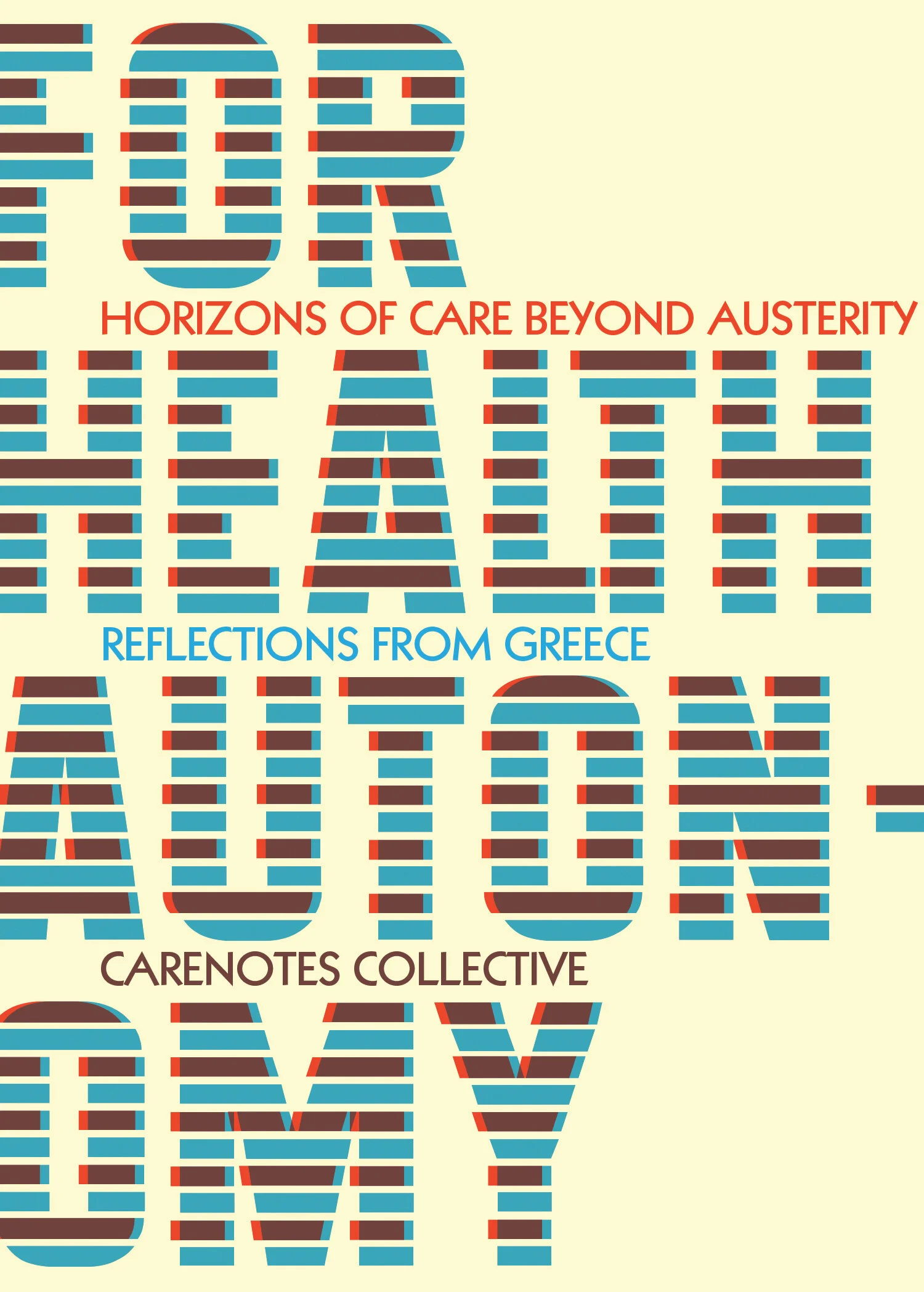
For Health Autonomy: Horizons of Care Beyond Austerity—Reflections from Greece

For Health Autonomy: Horizons of Care Beyond Austerity—Reflections from Greece
CareNotes Collective
Health & Care / Social Movements
The present way of life is a war against our bodies. Nearly everywhere, we are caught in a crumbling health system that furthers our misery and subordination to the structural violence of capital and a state that only intensifies our general precarity. Can we build the capacity and necessary infrastructure to heal ourselves and transform the societal conditions that continue to mentally and physically harm us?
Amidst the perpetual crises of capitalism is a careful resistance—organized by medical professionals and community members, students and workers, citizens and migrants. For Health Autonomy: Horizons of Care Beyond Austerity—Reflections from Greece explores the landscape of care spaces coordinated by autonomous collectives in Greece. These projects operate in fierce resistance to austerity, state violence and abandonment, and the neoliberal structure of the healthcare industry that are failing people.
For Health Autonomy is a powerful collection of first-hand accounts of those who join together to build new possibilities of care and develop concrete alternatives based on the collective ability of communities and care workers to replace our dependency on police and prisons.
Product Details
ISBN: 9781942173144
Published: January 2020
Format: Paperback
Size: 5 x 7 in
Page count: 144
Other Formats
ISBN: 9781942173359
Format: EPUB
For Health Autonomy is a powerful collection of first-hand accounts of those who join together to build new possibilities of care and develop concrete alternatives based on the collective ability of communities and care workers to replace our dependency on police and prisons.
-
Intensifying inequality and violence have heightened the need to deepen our capacity to resist, offer concrete alternatives, and reproduce ourselves in the process. CareNotes Collective organizes directly on this terrain and seeks to record and amplify the experiences of those struggling for health autonomy in their own communities. Our challenge is to imagine how to expand these practices while defending our communities from the risks of cooption, state violence, and emotional trauma as well as financial domination.
Despite the continued violence of the state and private sector, efforts to protect our bodies and environment continue to emerge from those of us left with few other means of sustaining daily life. Yet those who are excluded from the basic right to housing, health, food, safe spaces, emotional wellbeing, and so many other needs, are vilified. Simultaneously, the efforts of care workers committed to our general well-being (educators, healthcare, farm workers, social workers, neighbors, mothers, autonomous networks) are also devalued in an endless restructuring of “crisis.” One strategy is recognizing the centrality of care workers—mothers, the elderly, the pathologized, migrants, LGBTQ+ communities, and autonomous networks—in creating sites of counterpower where we can collectively defend and care for one another while resisting the violence of capitalist life. Such collective care has the potential to liberate space and time, to transform workflows within and beyond traditional care spaces, and to link networks otherwise separated by wealth, race, expertise, and geography.

Forthcoming, ships November 2026
Edited by Carla Orendorff, Anthony Orendorff, Lupita Limon Corrales, Ananya Roy, and Marisa Lemorande
Preface by Robin D. G. Kelley
Urban Studies / Health & Care / Organizing
Written by unhoused people and their allies, We Live in Public is an invitation to revolutionary care in a time of class war.
Los Angeles is one of the richest and most unequal cities in the world, where nine unhoused people die every day. As rent rises, evictions increase, and houselessness grows, the homeless encampment becomes both a symptom of organized abandonment and a site of insurgent knowledge and practice. We Live in Public was conceptualized and written by residents and organizers of one such encampment, Aetna Street, whose experiences offer strategies for solidarity and survival in the face of escalating state violence.
Many people’s worst fear is to be homeless, equating it with social death. But within the encampment, we see people living with wisdom and maps to offer. Throughout this book, Aetna residents and organizers generously share such insights and analysis. We Live in Public insists that these histories provide crucial lessons in modes of collective living and must be at the center of public history and knowledge.
Centering those who care for others on the street, it is an invitation to revolutionary care in the time of war. That war is the more immediate criminalization of homelessness and the longer arc of the unrelenting settlement of the US. We Live in Public is a refusal of such settler-colonial logics in the making of home and place.