
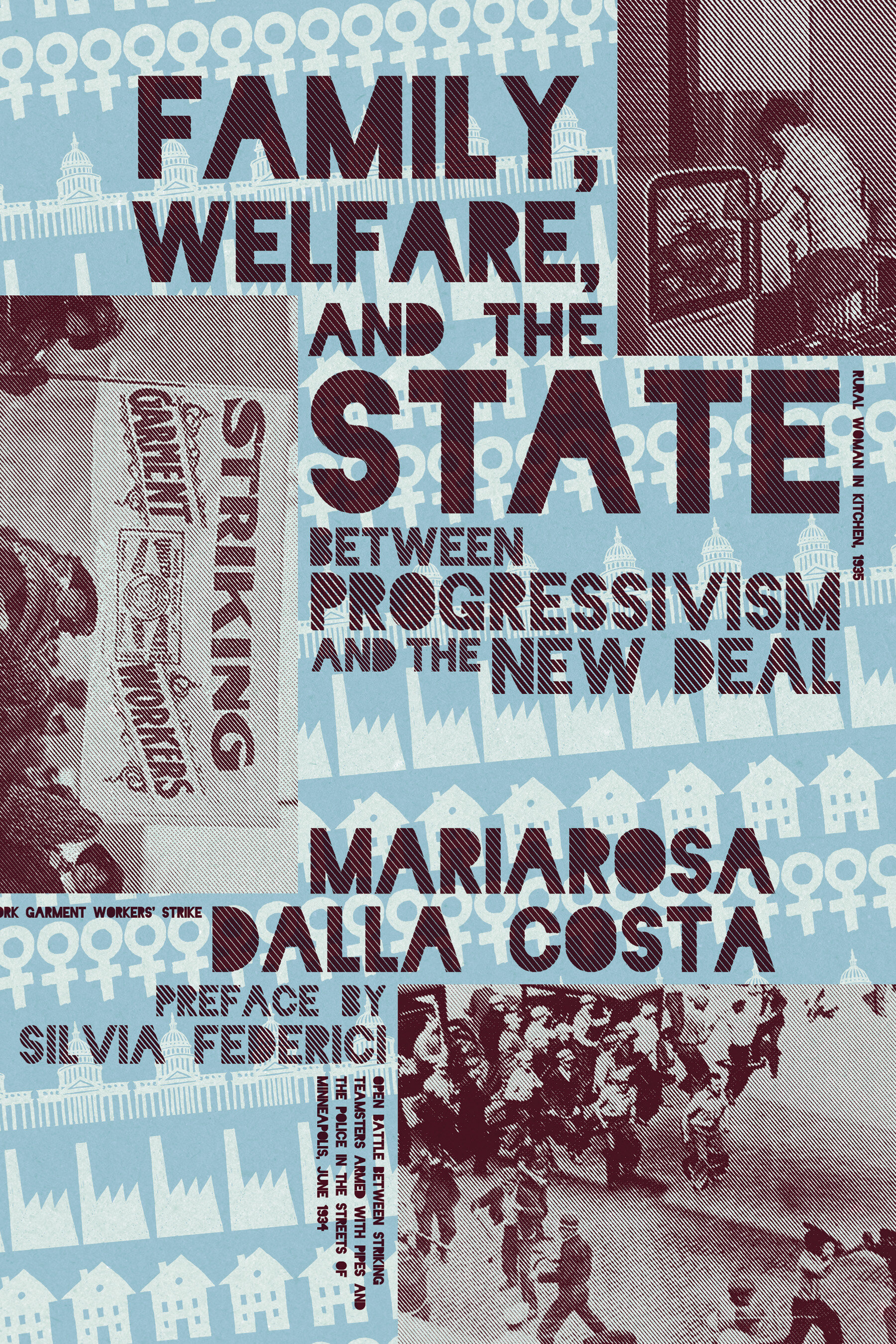
Family, Welfare, and the State: Between Progressivism and the New Deal

Family, Welfare, and the State: Between Progressivism and the New Deal
SECOND EDITION AVAILABLE HERE
Twenty years ago, President Clinton signed legislation to end "welfare as we know it." But did we ever really know it?
Mariarosa Dalla Costa’s Family, Welfare and the State powerfully reminds us that the welfare system can only be understood through the dynamics of resistance and struggle, and women have been at the center of it.
The attack on welfare was and is an attack on our class autonomy, structured to maintain a patriarchal and racist order, drive divisions and disrupt our ability to collectively refuse capital’s exploitation and the state’s discipline.
Dalla Costa reflects on the history of struggles around the New Deal in which workers’ initiatives forced a new relationship with the state on the terrain of social reproduction. Were the New Deal and the institutions of the welfare state the saviors of the working class, or were they the destroyers of its self-reproducing capacity?
Family, Welfare and the State offers a comprehensive reading of the welfare system through the dynamics of women's resistance and class struggle, their willingness and reluctance to work inside and outside the home, and the relationship with the relief structures that women expressed in the United States during the Great Depression.
Revisiting the origins of this system today on a sociopolitical level—its policies governing race, class, and family relations, especially in terms of the role that was delegated to women’s labor power—remains vital for a deeper understanding of the historical and ongoing relationship between women and the state, crisis and resistance, and possibilities for class autonomy.
Product Details
ISBN: 9781942173014
Published: July 1, 2015
Format: Paperback
Size: 8 x 5 in
Page count: 128
Other Formats
ISBN: 9781942173250
Format: EPUB


Raquel Gutiérrez Aguilar
Edited by Brian Whitener
Translated by JD Pluecker
Feminism / Latin America / Ecology / Social Movements
The essential political and theoretical work of one of Latin America’s most important contemporary theorists.
Raquel Gutiérrez Aguilar is one of the foremost Latin American political thinkers. From armed Indigenous struggle in the Bolivian altiplano to the contemporary wave of feminist uprisings, Raquel Gutiérrez's life and work have spanned and spurred on some of the most important political sequences in the last forty years in Latin America.
Almost unknown in the United States, Raquel is one of the Latin American anticapitalist, antistate Left's most important contemporary theorists. She has produced important work on communal struggles and political forms and has been at the center of some of the most important political organizing in Bolivia and Mexico in the last forty years.
This volume presents an extensive interview with Raquel in which she charts her political and intellectual trajectory from her militancy in the Ejército Guerrillero Tupac-Katari, to Bolivia's famous Water and Gas wars, to the massive wave of popular feminist rebellions and organizing. Translator and writer, Brian Whitner offers two essays in translation that contain some of her central theoretical concepts, including the veto and reappropriation of communal wealth, for thinking a politics in common, and of the commons.
With the publication of In Defense of Common Life, a new audience of English-language readers can finally engage with the thought and political experience of a think and militant, whose contributions to social movements spans an incredible political and regional breadth, and resonates deeply with current debates with the US about the conditions and practices of revolutionary change, feminism, and popular struggle.