
About the Nonaligned Series
Nonaligned is dedicated to fiction, literary nonfiction, and poetry that explores the historical and ongoing legacies of anticolonial politics, the evolving nature of imperialism, and the world-making freedom movements of our times. The series highlights vital and creative sources of internationalist imagination within the fractures and fault lines of the current world order. The name takes inspiration from the worldwide anticolonial and anti-imperialist self-determination movements that sparked a wave of decolonization in the 1960s and ’70s across Africa, Latin America, Asia, and the Arab world.
In the Nonaligned Series

Jiyar Jahan Fard
Translated by Chiya Parvizpur
Over a single day, a family faces grief and exile and history in a surreal tale set at contested borders.
On one side of the border, Azad’s mother stands in her grief, waiting to bury her son. On the other side, his uncle and cousins wait with his body, barred by unrelenting guards from bringing him home without a passport. Borders are a thousand kinds of violence, a vicious declaration of who belongs and who does not. For generations, the Kurdish people have lived divided by these cruelties, carved out amid the ruins of war and empire. This is The Shadeless Border.
Over the next twenty-four hours at the crossing, an uncanny tale unfolds through a chorus of surprising voices: Death and the Border speak to us like old friends; a coffin and a stringed instrument, both carved from the same tree, remember Azad’s family history. Set at the contested frontier between Iran and Iraq, Jiyar Jahan Fard’s masterpiece is a work of haunting intensity, written along the delicate line between Kafka and Kundera, and tracing the man-made boundaries that define the reality of modern-day Kurdistan.
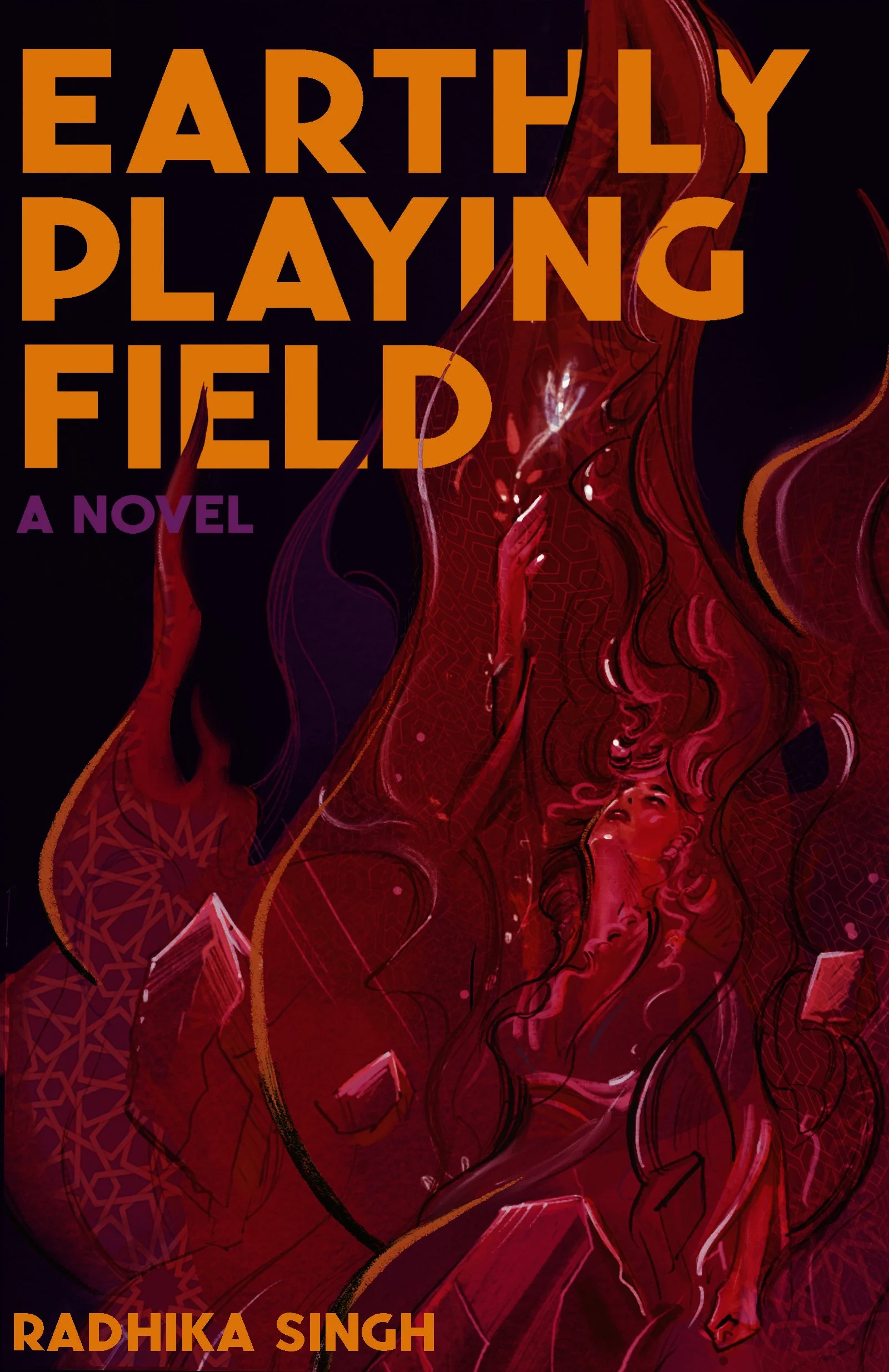
Radhika Singh
Fiction / Anticolonial Politics
Love and revolution in a crumbling world order.
Roma has a steady job, a mortgage, and a surrogate family in Queens. But as she moves through her daily routines, the powerful Empire that rules her world bares its teeth elsewhere—crushing freedom movements across the planet, including the Punjabi farmers’ uprising where her younger brother struggles on the frontlines.
Roma’s life is upended when her older brother entrusts her with a strange gift: an ordinary-looking plant that manifests a sophisticated bioengineered technology. The ‘cell’ opens a portal for an extraterrestrial spirit-body bearing news of a liberated future–and the potential to hack AI warfare—propelling Roma and her family into the core of a rising resistance.
As dreams and dialectics converge, Roma meditates on the role of faith, ruminating on mystic poetics and anticolonial legacies while yearning for a bewitching woman whose heart will only ever belong to the revolution.

J. M. Holmes
A novel about family, scarcity, and what it means to sell out as the world ends.
The world hasn’t quite ended, but it’s getting there. Me and Mine imagines a not-so-distant future on the pre-apocalyptic shores of Lake Michigan. The West has dried up, the watershed has been contaminated, and water scarcity has driven most of the population inward from the coasts. Here, real estate interests run rampant and the possibility of snagging a house close enough to the Great Lakes to get fresh water has realigned global financial interests. And, as always, the working class is being pushed aside to make way for white and wealthy newcomers.
Amidst the chaos, three brothers try to navigate this swiftly changing landscape. As one seeks influence in politics, the younger two are drawn into the dangerous, shadowy world of private security and militias. In the precarious new world that these three brothers navigate, J. M. Holmes offers a grim yet familiar future in which scarcity fuels resentment, resentment sparks extremism, and extremism ignites around the racial tensions of our present.

Steven Salaita
Rodrigo Suarez’s Coyote Road is a veritable smash hit. Anyone who’s anyone is reading it, and the accolades and speaking invitations are pouring in. There is just one problem: Rodrigo didn’t write it. Jerry Turley did. And no one believes him.
Thus, Jerry—an unimpressive professor at an Appalachian university—embarks on an obsessive, self-destructive crusade to prove his authorship and expose Rodrigo as a thief and an impostor. It doesn’t take much Googling to discover that “Rodrigo” is not the man he claims to be. Convincing people to care about it proves much harder.
In this uncomfortable campus farce, Steven Salaita holds a mirror to the nagging questions of authenticity and appropriation that occupy college campuses and literary institutions alike, daring to ask us who really stands to benefit from our era of sensitivity and self-regard.

Ata Nahai
Translated by Chiya Parvizpur & Hourieh Maleki Qouzloo
Introduction by Kawan Mohammadpur
A kaleidoscopic novel of politics, identity, and dislocation in the wake of the Islamic Revolution.
Some years after the overthrow of the Shah, Mehraban has returned to Iran after a period of wandering and isolation to write the story of a famed Kurdish revolutionary named Farhad. Guided by our unnamed narrator, Mehraban pursues his story and its living-dead subject, learning that he and Farhad share bittersweet memories of a lost love amid fractured historical nightmares. Trapped in consciousness, trapped by mortality, trapped in a world that is not and cannot be objective, Birds in a Gale turns in on itself, entangling Mehraban’s and Farhad’s once-separate identities irrevocably, before rejecting the objective altogether.
Originally published in 2002, Birds in a Gale is a poignant, psychological, and deeply political effort by one of Kurdistan’s best-loved writers to restore the Kurds to their rightful place in revolutionary history. This inventive metatext, lucidly translated by Chiya Parvizpur and Hourieh Maleki Qouzloo, is reminiscent of the best of George Saunders and Elias Khoury, and an instant classic of twenty-first century world literature.

Yaffa AS
Fiction & Literary Nonfiction / Anticolonial Politics
When you think of freedom, where are you? And where are you headed? Dreaming of freedom from within the occupied and displaced worlds of Palestine, Letters from a Living Utopia engages with utopia as both a destination and a potential present. Addressing past and future selves among other crucial figures, Mx. Yaffa builds epistolary bridges in these pages, connecting the historical struggle for liberation of the land and its people with the intimate ways that we can recover hope–now and in the years to come.
Emerging during a time of generational dispossession, monstrous genocide, and personal pain, Letters from a Living Utopia is a journey of resilient repair that will leave every reader with the deeply felt certainty that Palestine will be free, but also that Palestine has always been free.

Sharam Qawami
Translated by Kiyoumars Zamani
Edited by Patrick Germain
Fiction / Anticolonial Politics
A young Kurdish woman discovers a commitment to liberation, both personal and collective, through a harrowing journey in Rojava with armed freedom fighters.
Jînçin is a young professor living in Berlin, born to a Yezedi father who years earlier was shunned and exiled for marrying outside his community, but who late in life makes the surprising decision to return to his homeland to defend his people and join the Kurdish People's Defense Units (YPG) in their fight against the Islamic State.
Searching for an understanding of why the father she adored would give his life for such a cause, the young woman journeys to the remote mountains of northeastern Syria, into the autonomous Kurdish region of Rojava, to join the freedom struggle. With little training and without warning, she immediately confronts the extremist threat that faces the Kurds, from bloody skirmishes with ISIS to drone strikes and the clandestine operations and brutal human rights abuses of the Turkish military.
Her new life as a guerrilla is a bitter and arduous one, defined by party discipline and sustained only by the most basic meals, river water, and the rare goods that can be smuggled into the mountains. At first, Jînçin finds such an austere existence intolerable and resolves to flee from the seemingly doomed experiment in Kurdish autonomy. As she contemplates abandoning the new comrades she begins to realize the hidden complexity of the society in formation around her, full of philosophizing, humor, and affection. She gains profound insights into her own history and heritage, the struggles that Kurds and particularly the Yezidis face, as well as the richness of life in a gender-liberated society, and the practice of democracy in an autonomous society.
Transformed in the heat of battle and by the demands of living and fighting shoulder-to-shoulder with her comrades, the illusions that unwittingly restrain Westerners’ freedoms and their comprehension of the world around them fall away. Over months of mournful, intimate, and often-times playful conversations, as well as narrow escapes from grave danger, Jînçin finally grasps her place and her purpose in the world. She and her comrades grow to gain a mutual sense of understanding and solidarity that permits them, in spite of the odds stacked against them, to achieve remarkable acts of resistance against the forces of domination that seek to destroy their life, dignity, and freedom.
Ultimately, Rojava is the story of people from the same social stratum who have decided, regardless of the present world order, to build a society free from any discrimination, based on the dignity and autonomy of individuals with religious, ethnic, ideological, and gender differences.

Sónia Vaz Borges, Maria Isabel Vaz
Anticolonial Politics / Literary Nonfiction
A memoir of a mother and daughter’s return to Cape Verde reveals the legacies of national liberation, a story of memory and migration, and the psychic and physical landscape that colonialism has wrought.
When Sonia Vaz Borges accompanied her mother, Maria Isabel Vaz, home to Santiago Island, Cape Verde, it was the first time she experienced the island where her mother and family were born, and where her mother left forty years earlier. As a historian, documentarian, and a Black Cape Verdean young woman born in Portugal, she booked a trip to a native land she’s never been to in order to conduct research on the history of militant resistance to Portuguese colonialism, of the education initiatives of the African Party for the Independence of Guinea Bissau and Cape Verde (PAIGC), and the lessons for freedom available for today.
What she discovers are lifelong lessons as illuminating as anything her PhD revealed to her. The fragments of memories, episodes, and encounters in Cape Verde that she assembled in this travel diary reveal an experience of “homegoing” that is rich with the legacies of national liberation, the story of a Black woman’s migration during the height of colonial oppression, of separation from family and nation, and memories of an island transformed since Independence, and the psychic and physical landscape that the legacy of colonial rule has wrought. As mother and daughter travel home together for the first time, they embark on a journey that takes them to new places in their relationship to each other, a return and a rediscovery of a place and people imagined and conjured through memory, where history and place blur and where stories are created and shared.
Ragás is a Cape Verdean creole word for the space created between the waist and the knees when seated: the lap. Here, it is a place to find nurturing, a place to be embraced, protected, and cared for, a place for reconnection and return to the memories that others carry for you when migration means both leaving and being left behind.

Steven Salaita
Fiction / Anticolonial Politics
A story of family bonds amid political betrayal that explores the drastic steps that a young girl will take in order to find a sense of belonging.
Fred is lost, confused, almost certainly about to die. As he traces his steps back from the desert where he has been dropped by soldiers of a repressive Gulf Kingdom regime, his nine-year-old daughter, Nancy, is doing the same from six thousand miles away in a quiet neighborhood in the suburbs of Washington, DC.
With his disappearance, she and her mother are forced to leave their comfortable house in DC for a new life in Virginia. Abandoned by their friends and desperate for answers, Nancy and her mother must acclimate to the strange world of suburban anonymity. As Nancy grows into adulthood, she pieces together what happened to her father and devises a bold plan to avenge his disappearance.
Unraveling an international web of deceit in order to find her father will take time and patience; and becoming a cold-blooded assassin takes commitment to a life at odds with everything she knows.
Seraj Assi
Fiction / Anticolonial Politics
Nonaligned
A Palestinian novel about witnessing a massacre, and worse still, surviving it.
Resurrected in Heaven, a bewildered survivor of a massacre flashes back to harrowing events unfolding in an unnamed besieged town, a camp ravished by hunger and swollen with displaced people and starving children, where a hopeful euphoria building at a breadline culminates in a tragedy and bleak dissolution. Centered on the theme of hunger, the essence of bread, and the magic of flour in a place on the brink of mass starvation, Red Flour is essentially a love story that takes place in a breadline. “But can love blossom in a place ravished by hunger?”
Languishing under an unending siege and constant bombardment, the camp soon dwindles into a necropolis where bone-thin children wither away in the arms of hapless parents, dying a most agonizing death, before being loaded hurriedly into waiting wagons and buried in haste. And beyond starvation a flour massacre unfolds, leading to the protagonist’s cry: “Even our bread is massacred, murdered before it’s leavened.”
This is a compelling story of death and survival, of bread and roses, in a world in which humanity is at a brink.