
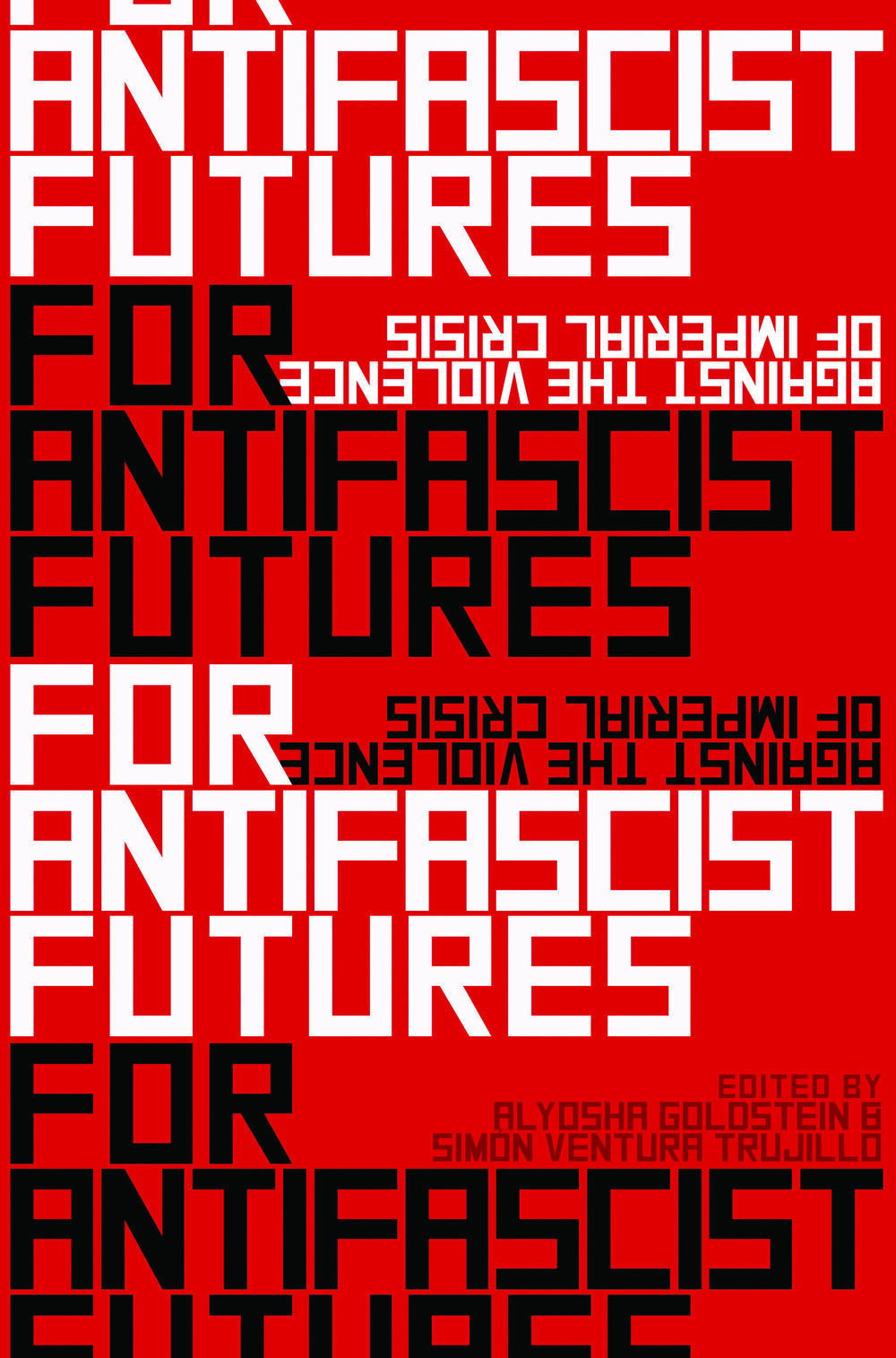
For Antifascist Futures: Against the Violence of Imperial Crisis
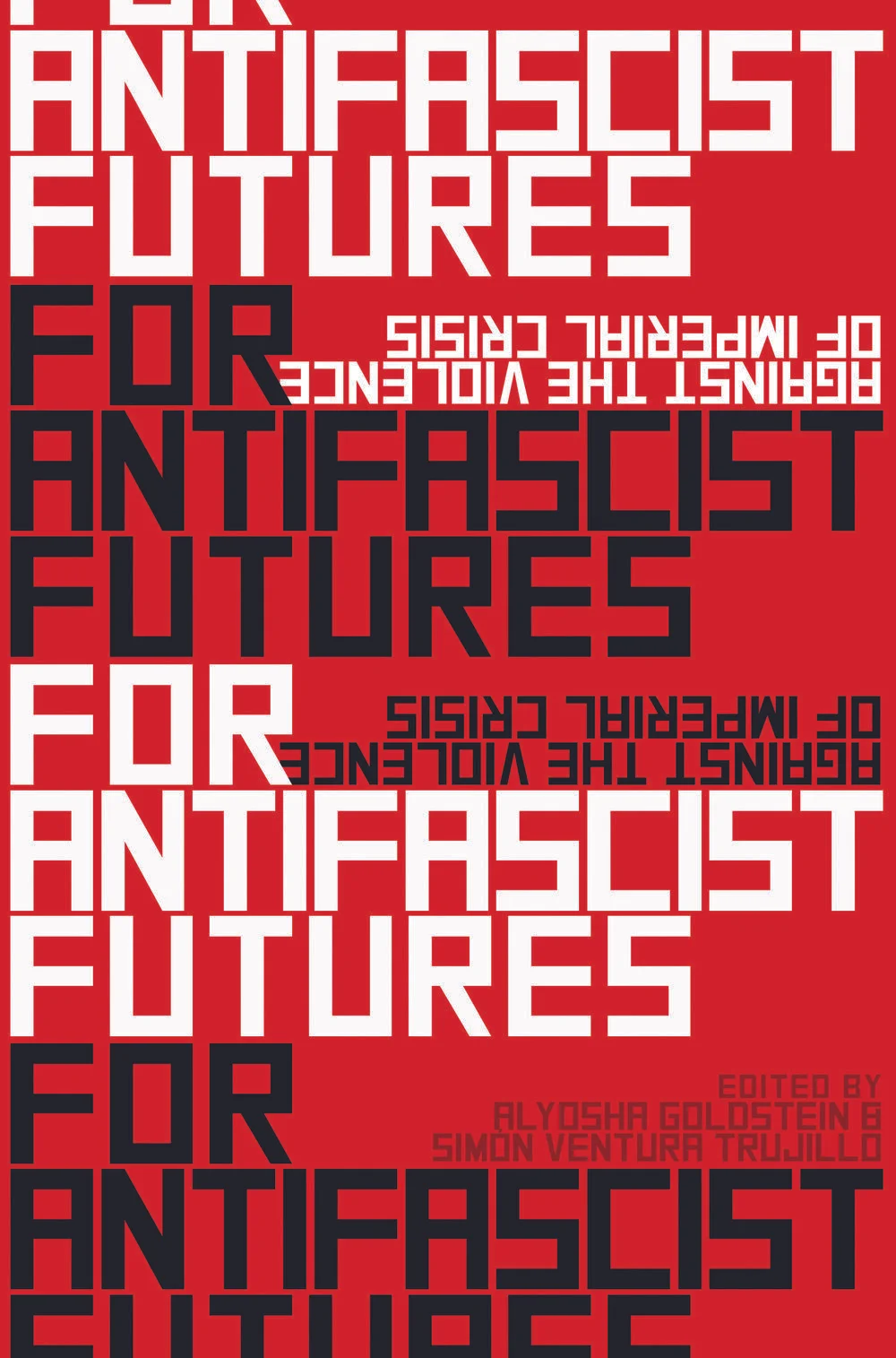
For Antifascist Futures: Against the Violence of Imperial Crisis
Edited by Alyosha Goldstein and Simón Ventura Trujillo
Antifascist Politics / Organizing
Explores the significance of fascism for understanding authoritarianism today and centers anti-imperialist movements of Black, Indigenous, and colonized peoples.
We must, as For Antifascist Futures urges, take antifascism as a major imperative of movements for social change. But we must not limit our analysis or historical understanding of the rise of the right-wing authoritarianism in our times by rooting it in mid-twentieth century Europe. Instead we turn to a collection of powerful BIPOC voices who offer a range of anticolonial, Indigenous, and Black Radical traditions to think with.
For Antifascist Futures takes seriously what is new in this moment of politics, exploring what the analytic of fascism offers for understanding the twenty-first century authoritarian convergence by centering the material and speculative labor of antifascist and antiracist social movement coalitions. By focusing on the long history of Black and Brown antifascist resistance that has been overlooked in both recent conversations about racial justice as well as antifascist resistance, the essays, interviews, and documents included here make clear how racialized and colonized peoples have been at the forefront of theorizing and dismantling fascism, white supremacy, and other modes of authoritarian rule.
By linking a deep engagement, both scholarly and practical, of racial justice movements with an antifascist frame, and a global analysis of capitalism the contributors have assembled a powerful toolbox for our struggles. The editors, widely recognized ethnic and American studies scholars, offer a groundbreaking collection with contributions from Johanna Fernandez, Manu Karuka, Charisse Burden-Stelly, Zoé Samudzi, and Macarena Gomez-Barris among others.
Product Details
ISBN: 9781942173564
Published: April 2022
Format: Paperback
Size: 6 x 9 in
Page count: 304
Other Formats
ISBN: 9781942173649
Format: EPUB
-
"This extraordinary volume ranges over a planetary geography and deeply engages historical formations and trajectories of fascism and antifascism. The authors, writing in a variety of genres and from many fields of study, illuminate the makings of racialized violence, the role of untruths, post-truths, and ideologies, the afterlives and ongoing effects of colonial force, and the role of capital accumulation in the making of modern varieties of fascism. Every page of For Antifascist Futures forces us to face and reckon with the lacerating effects of fascist power on the body politic”—Laleh Khalili, author of Sinews of War and Trade and Time in the Shadows
"Globalizing and reframing fascisms on a world scale, this urgent and powerful volume analyzes fascism as the convergence of authoritarian state and extralegal racial nationalist violence responding to the historical and material crises of capitalism and imperialism. The collection constellates a stunning range of antifascist practices, from Black radical internationalism, anticolonial movements, and insurgencies in the Philippines, Palestine, and South Asia, and across Latin America and Africa, on the one hand, to a long history of antifascisms and racial justice movements in the U.S. and Indigenous demands for return of stolen land, on the other.”—Lisa Lowe, author of The Intimacies of Four Continents
“For Antifascist Futures is a searing and necessary collection for our times. The precise and unsparing indictment of fascism—and its enduring entanglements in imperialist and capitalist expansion—is the urgent world-making project that we all need. By deftly engaging the analytic of fascism across time and geography, this constellation of intellectually & politically fierce essays narrates a simultaneously sobering and inspiring political vision of internationalist antifascism against authoritarianism. This book is a tour de force.”—Harsha Walia, author of Border and Rule and Undoing Border Imperialism
-
Read Chapter 3: On the Historical Roots of US Fascism by Johanna Fernández
-
Reframing and pluralizing fascism through a cartography of anticolonial and decolonial struggle that does not take Europe as the center is a challenge that asks us to reckon with the emergence of fascism as shaped by continuities and ruptures among feudalism, industrial capitalism, imperialism, colonialism, and liberalism. We are thus less concerned in this special issue with the “proper” historically delimited event of fascism in Europe between 1919 and 1945 than with the broad resonance and rhetorical salience of fascism.[i] Acknowledging that fascism as such is always shaped by the dynamics of particular places and conjunctures, most salient in this regard is an analysis that simultaneously de-exceptionalizes fascism and seeks to comprehend its specificity in an expanded global context. In her 1923 address and resolution for the Enlarged Plenum of the Communist International’s Executive Committee, Clara Zetkin argued that “fascist forces are organizing internationally, and the workers’ struggle against fascism must also organize on a world scale.”[ii] She contended that fascism emerged as a “sham revolutionary program” in response to “the imperialist war and the accelerated dislocation of the capitalist economy,” and as a necessary counterforce, “in contrast to the Second International, the Comintern is not an International for the elite of white proletarians of Europe and America. It is an International for the exploited of all races.”[iii] The global arena of racialized violence, plunder, and exploitation was in this sense an arena extended through imperialism and colonialism.
Between the end of the First World War and the early Cold War, numerous anticolonial writers of color emphasized the direct connection between the atrocities of imperialism and fascism. They persuasively argued that fascism was fundamentally entangled with the form and practice of colonial rule, racialized organization of dispossession and death, and insatiable imperial aspiration in order to insist that defeating fascism required ending all manner of colonialism and imperialism. George Padmore first wrote about what he called “colonial fascism” in How Britain Rules Africa (1936), further developing this analysis in publications over the next two decades.[iv] In his 1938 address to the conference on Peace and Empire, Jawaharlal Nehru observed that “the essence of the problem of peace is the problem of empire,” declaring that fascism is simply an “intensified form of the same system which is imperialism.”[v] Writing in 1949, Claudia Jones called attention to the “growth of militancy among Negro women” as having “profound meaning, both for the Negro liberation movement and for the emerging anti-fascist, anti-imperialist coalition.”[vi] In the wake of the Second World War and rising tide of anticolonial independence movements, in Discourse on Colonialism (1950/1955) Aimé Césaire described the “decivilizing” consequences of colonialism for colonizers themselves as a root cause of Nazism and other Euro-American fascisms.[vii] During the present conjuncture, when the question of fascism appears resurgent, genealogies of anticolonial and anti-imperialist critique are indispensable for understanding and dismantling the far-reaching entanglements of rightwing authoritarianism.
Fascism as a heuristic in this sense can be thus important for several reasons. First, an analytic of fascism situates rightwing reaction within the historical and material crises of imperialism of which fascism is in some fundamental sense symptomatic. To invoke fascism is to place various iterations of authoritarianism and state and extralegal violence directly in relation to racial and gendered capitalist crisis and the expanded reproduction of imperialism. Second, the mass appeal of authoritarian nationalism and white supremacy has been historically galvanized during moments of accelerated insecurity and potential displacement of the so-called middle class. For instance, Trump’s base was and remains primarily middle-income white people as well as particular fractions of corporate capital and is not principally a movement of working-class or impoverished white people, even if it has also successfully recruited from these sectors. Third, fascism as an embrace of punitive governance partially animated by a politics of fear, cruelty, racism, and heteropatriarchy is essentially reactionary. This reactionary appeal to the certainty of authority and order against demonized and otherized groups emerges in opposition to the promise and popularity of a radical politics of redistribution (for instance, in relation to anarchist and communist revolutionary movements during the interwar period and Cold War era) and abolition (as against the Movement for Black Lives and initiatives to defund the police today). During the current moment, it is also a revanchist alignment against the momentum of trans* and queer liberation, climate justice, migrant and asylum seeker assertions of life against border imperialism, and Indigenous peoples’ demands for the return of stolen land. This reactionary disposition is of the utmost significance, especially in that it requires a focus on that against which it is organized and defined — although horrific, raw power and rule by violence in this sense are in many ways the least stable basis of authority and control.[viii]
Without overstating continuities or equivalencies, we contend that naming fascism often serves to index the relationship among state power, imperialism and colonization, religious/racist nationalism, and white supremacist terrorism as the reactive conditions of counterrevolution and racial capitalism. The racial terror and genocide wrought by slavery and colonialism preceded, were co-constitutive of, and continue after Mussolini’s Fasci Italiani di Combattimento, the National Socialist German Workers’ Party, and Japan’s Shōwa nationalism. There are multiple valences for an expanded frame of fascisms. Among the most frequently referenced examples of links between European fascism and colonial policy are Germany’s 1904-1908 genocide against the Herero and Nama peoples in South West Africa (now Namibia) and U.S. policy toward Indigenous peoples and Jim Crow laws as models emulated by the Third Reich.[ix] In the immediate aftermath of the Second World War, African American petitions to the United Nations, such as W. E. B. Du Bois and the NAACP’s 1947 An Appeal to the World: A Statement of Denial of Human Rights to Minorities in the Case of citizens of Negro Descent in the United States of America and an Appeal to the United Nations for Redress — which condemns the U.S. as part of “the imperialist block which is controlling the colonies of the world” — and the 1951 Civil Rights Congress’s We Charge Genocide: The Crime of the Government Against the Negro People were exemplary of a burgeoning Black antifascism.[x] In turn, similar demands for redress and liberation framed in relation to fascism extended through the 1955 Bandung Conference, the 1966 Tricontinental Conference, and the growing momentum for worldwide decolonization.[xi]
During the 1960s and 1970s, the Black Panther Party likewise called out as fascist the constitutive white supremacism and imperialism of the United States — brutally enacted by the everyday actions of the police, counterinsurgency operations, and the military — and sought to build a broad coalition of activists with such initiatives the United Front Against Fascism conference in 1969.[xii] Activist groups such as the John Brown Anti-Klan Committee and Anti-Racist Action in the United States and the Anti-Nazi League and Anti-Fascist Action in Britain were explicitly organized against the fascism of the racist New Right and skinhead gangs of the 1970s and 1980s.[xiii] More recently, a heterogeneous group of antifascist organizations, initiatives, and actions sometimes collectively referred to as Antifa — or, in the case of Donald Trump’s “anti-Antifa” campaign, conjured into a single vilified and violent organization — have mobilized against rightwing and white racist terrorism. In each of these instances, the continuities, tensions, and disjunctions of what gets named fascism in particular times and places matter within and across national and international frames. We aim to think with such genealogies to further question how fascism as a heuristic can be further situated with respect to imperialism and settler colonialism as well as what such a heuristic might offer with regard to anticolonial thought and action as one especially salient arena of struggle.
[i] Matthew N. Lyons, Insurgent Supremacists: The U.S. Far Right’s Challenge to State and Empire (Oakland, CA: PM Press, 2018).
[ii] Clara Zetkin, Fighting Fascism: How to Struggle and How to Win, ed. Mike Taber and John Riddell (Chicago, IL: Haymarket Books, 2017), 73.
[iii] Zetkin, Fighting Fascism, 34, 67, 61.
[iv] George Padmore, How Britain Rules Africa (1936; New York: Negro Universities Press, 1969).
[v] Quoted in Michele Louro, Comrades against Imperialism: Nehru, India, and Interwar Internationalism (Cambridge: Cambridge University Press, 2018), 230.
[vi] Claudia Jones, “An End to the Neglect of the Problems of Negro Women” (1949), in Claudia Jones: Beyond Containment, ed. Carole Boyce Davies (Oxfordshire: Ayebia Clarke Publishing, 2011), 74.
[vii] Aimé Césaire, Discourse on Colonialism, trans. Joan Pinkham (1950; New York: Monthly Review, 2000).
[viii] Kyle Burke, Revolutionaries for the Right: Anticommunist Internationalism and Paramilitary Warfare in the Cold War (Chapel Hill: University of North Carolina Press, 2018); Gerald Horne, White Supremacy Confronted: U.S. Imperialism and Anti-Communism vs. the Liberation of Southern Africa from Rhodes to Mandela (New York, NY: International Publishers, 2019); Daniel Geary, Camilla Schofield, and Jennifer Sutton, eds., Global White Nationalism: From Apartheid to Trump (Manchester: Manchester University Press, 2020).
[ix] Zoé Samudzi, “Reparative Futurities: Thinking From the Ovaherero and Nama Colonial Genocide,” The Funambulist 30 (July-August 2020); Jürgen Zimmerer and Joachim Zeller, eds., Genocide in German South-West Africa: The Colonial War of 1904–1908 and Its Aftermath (London: Merlin Press, 2008); James Q. Whitman, Hitler’s American Model: The United States and the Making of Nazi Race Law (Princeton, NJ: Princeton University Press, 2017); Edward B. Westermann, Hitler’s Ostkrieg and the Indian Wars: Comparing Genocide and Conquest (Norman: University of Oklahoma Press, 2016); Jens-Uwe Guettel, German Expansionism, Imperial Liberalism and the United States, 1776–1945 (Cambridge: Cambridge University Press, 2012). For a generative resituating of the Nazi Holocaust in relation to the context of decolonization see Michael Rothberg, Multidirectional Memory: Remembering the Holocaust in the Age of Decolonization (Stanford: Stanford University Press, 2009).
[x] Highlighting the significance of Black antifascism, Christine Hong argues that “Black radicals during World War II wielded the term fascism to expose the illegitimacy and counterrevolutionary nature of the racial capitalist state, including waging its domestic war” against Black people. Christine Hong, A Violent Peace: Race, U.S. Militarism, and Cultures of Democratization in Cold War Asia and the Pacific (Stanford: Stanford University Press, 2020), 183.
[xi] See Adom Getachew, Worldmaking after Empire: The Rise and Fall of Self-Determination (Princeton, NJ: Princeton University Press, 2019); Luis Eslava, Michael Fakhri, and Vasuki Nesiah, eds., Bandung, Global History, and International Law: Critical Pasts and Pending Futures (Cambridge: Cambridge University Press, 2017); Quỳnh N. Phạm and Robbie Shilliam, eds., Meanings of Bandung: Postcolonial Orders and Decolonial Visions (New York: Rowman & Littlefield, 2016); Christopher J. Lee, ed., Making a World After Empire: The Bandung Moment and Its Political Afterlives (Athens: Ohio University Press, 2010); Anne Garland Mahler, From the Tricontinental to the Global South: Race, Radicalism, and Transnational Solidarity (Durham, NC: Duke University Press, 2018); John Munro, The Anticolonial Front: The African American Freedom Struggle and Global Decolonisation, 1945-1960 (Cambridge: Cambridge University Press, 2017); Vijay Prashad, The Darker Nations: A People’s History of the Third World (New York: The New Press, 2007); and Robin D. G. Kelley, “A Poetics of Anticolonialism,” in Césaire, Discourse on Colonialism, 7-28.
[xii] Robyn C. Spencer, “The Black Panther Party and Black Anti-Fascism in the United States,” January 26, 2017, https://dukeupress.wordpress.com/2017/01/26/the-black-panther-party-and-black-anti-fascism-in-the-united-states/. See also Robyn C. Spencer, The Revolution Has Come: Black Power, Gender, and the Black Panther Party in Oakland (Durham, NC: Duke University Press, 2016); Joshua Bloom and Waldo E. Martin Jr., Black against Empire: The History and Politics of the Black Panther Party (Berkeley: University of California Press, 2016).
[xiii] Hilary Moore and James Tracy, No Fascist USA!: The John Brown Anti-Klan Committee and Lessons for Today’s Movements (San Francisco, CA: City Lights Books, 2020); David Renton, Never Again: Rock Against Racism and the Anti-Nazi League 1976-1982 (New York: Routledge, 2018). For an excellent primary source survey of the U.S. context, see Bill V. Mullen and Christopher Vials, eds., The U.S. Anti-Fascism Reader (Brooklyn, NY: Verso, 2020).
-
Alyosha Goldstein is a professor of American Studies at the University of New Mexico. He is the author of Poverty in Common: The Politics of Community Action during the American Century, editor of Formations of United States Colonialism (2014), and coeditor (with Jodi A. Byrd, Jodi Melamed, and Chandan Reddy) of “Economies of Dispossession: Indigeneity, Race, Capitalism,” a special issue of Social Text (2018), (with Juliana Hu Pegues and Manu Vimalassery [Karuka]) of “On Colonial Unknowing,” a special issue of Theory & Event (2016) and (with Alex Lubin) of “Settler Colonialism,” a special issue of South Atlantic Quarterly (2008).
Simón Ventura Trujillo is an assistant professor in the English Department at New York University and the author of Land Uprising: Native Story Power and the Insurgent Horizons of Latinx Indigeneity (2020).


Seraj Assi
Fiction / Anticolonial Politics
Nonaligned
A Palestinian novel about witnessing a massacre, and worse still, surviving it.
Resurrected in Heaven, a bewildered survivor of a massacre flashes back to harrowing events unfolding in an unnamed besieged town, a camp ravished by hunger and swollen with displaced people and starving children, where a hopeful euphoria building at a breadline culminates in a tragedy and bleak dissolution. Centered on the theme of hunger, the essence of bread, and the magic of flour in a place on the brink of mass starvation, Red Flour is essentially a love story that takes place in a breadline. “But can love blossom in a place ravished by hunger?”
Languishing under an unending siege and constant bombardment, the camp soon dwindles into a necropolis where bone-thin children wither away in the arms of hapless parents, dying a most agonizing death, before being loaded hurriedly into waiting wagons and buried in haste. And beyond starvation a flour massacre unfolds, leading to the protagonist’s cry: “Even our bread is massacred, murdered before it’s leavened.”
This is a compelling story of death and survival, of bread and roses, in a world in which humanity is at a brink.