
In One Hand the Gun: Militancy in South Asia [Jamhoor Magazine]
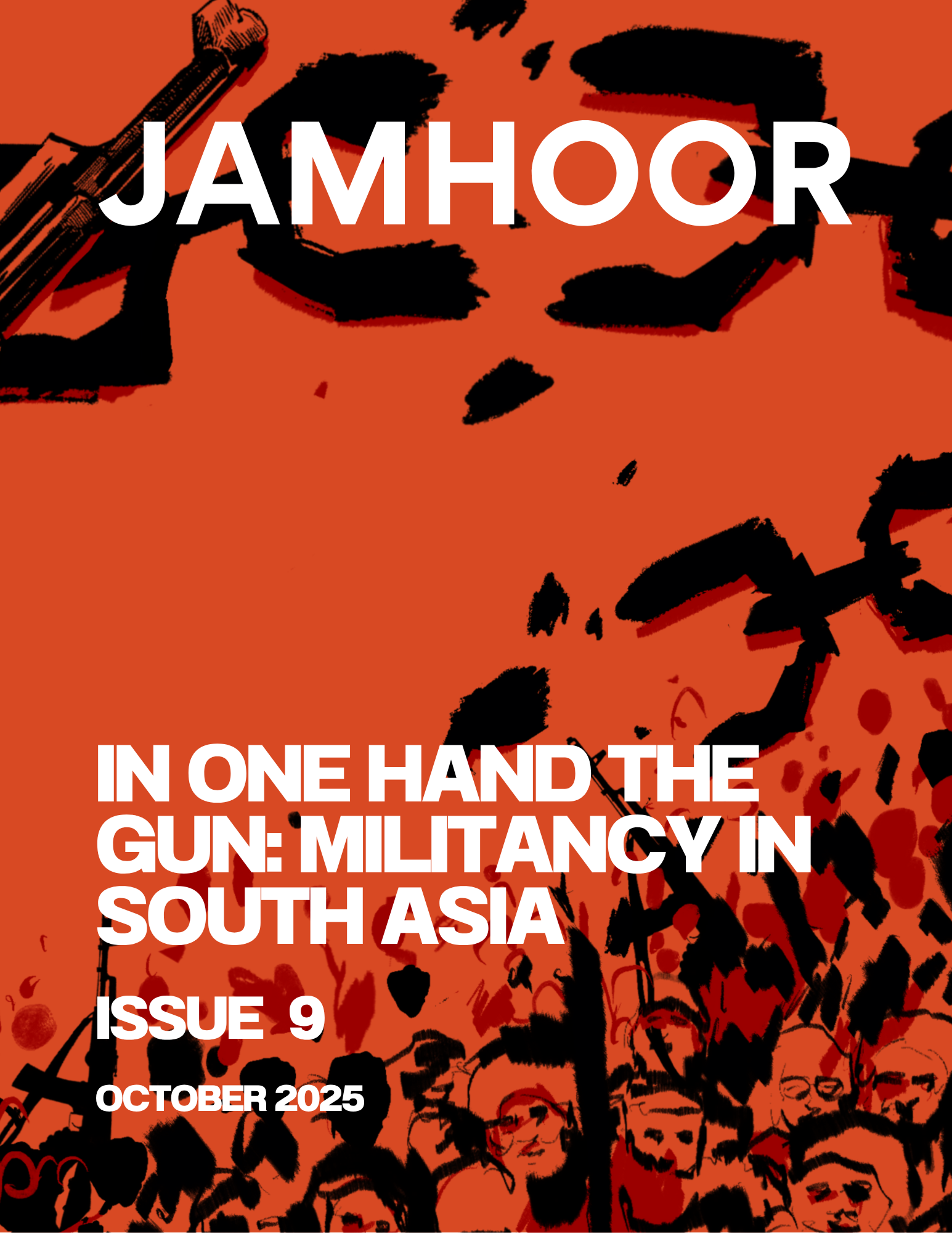
In One Hand the Gun: Militancy in South Asia [Jamhoor Magazine]
This issue explores armed resistance from the vantage point of South Asia. It delves into debates surrounding revolutionary violence and seeks answers in the subcontinent. Thanks to the glorification of Gandhi and his non-violent tactics, South Asia occupies a prominent place in the alleged success story of pacifism. Yet it is also a region where numerous national liberation and anti-imperialist struggles show that revolutionary violence has often been a key instigator and driver of history’s so-called locomotive. The issue presents the political and historical contexts that necessitated such revolutionary violence in lesser-known liberation movements across South Asia, from Balochistan to Bangladesh.
Launched in 2018, Jamhoor is a Left media platform for South Asia and its diasporas. Our name — “the people” in Urdu — distills our commitments: we are for the people. To be for the people means understanding and combating the structures that weigh us down: imperialism, capitalism, patriarchy, casteism, racism, and queerphobia. To be for the people is to refuse the borders that divide us: it is internationalism. To be for the people is to imagine and build radical alternatives that let us thrive: it is to remake the world.

Seraj Assi
Fiction / Anticolonial Politics
Nonaligned
A Palestinian novel about witnessing a massacre, and worse still, surviving it.
Resurrected in Heaven, a bewildered survivor of a massacre flashes back to harrowing events unfolding in an unnamed besieged town, a camp ravished by hunger and swollen with displaced people and starving children, where a hopeful euphoria building at a breadline culminates in a tragedy and bleak dissolution. Centered on the theme of hunger, the essence of bread, and the magic of flour in a place on the brink of mass starvation, Red Flour is essentially a love story that takes place in a breadline. “But can love blossom in a place ravished by hunger?”
Languishing under an unending siege and constant bombardment, the camp soon dwindles into a necropolis where bone-thin children wither away in the arms of hapless parents, dying a most agonizing death, before being loaded hurriedly into waiting wagons and buried in haste. And beyond starvation a flour massacre unfolds, leading to the protagonist’s cry: “Even our bread is massacred, murdered before it’s leavened.”
This is a compelling story of death and survival, of bread and roses, in a world in which humanity is at a brink.