
Not Afraid of the Ruins: Stories and Ideas from Worlds Beyond Capitalism
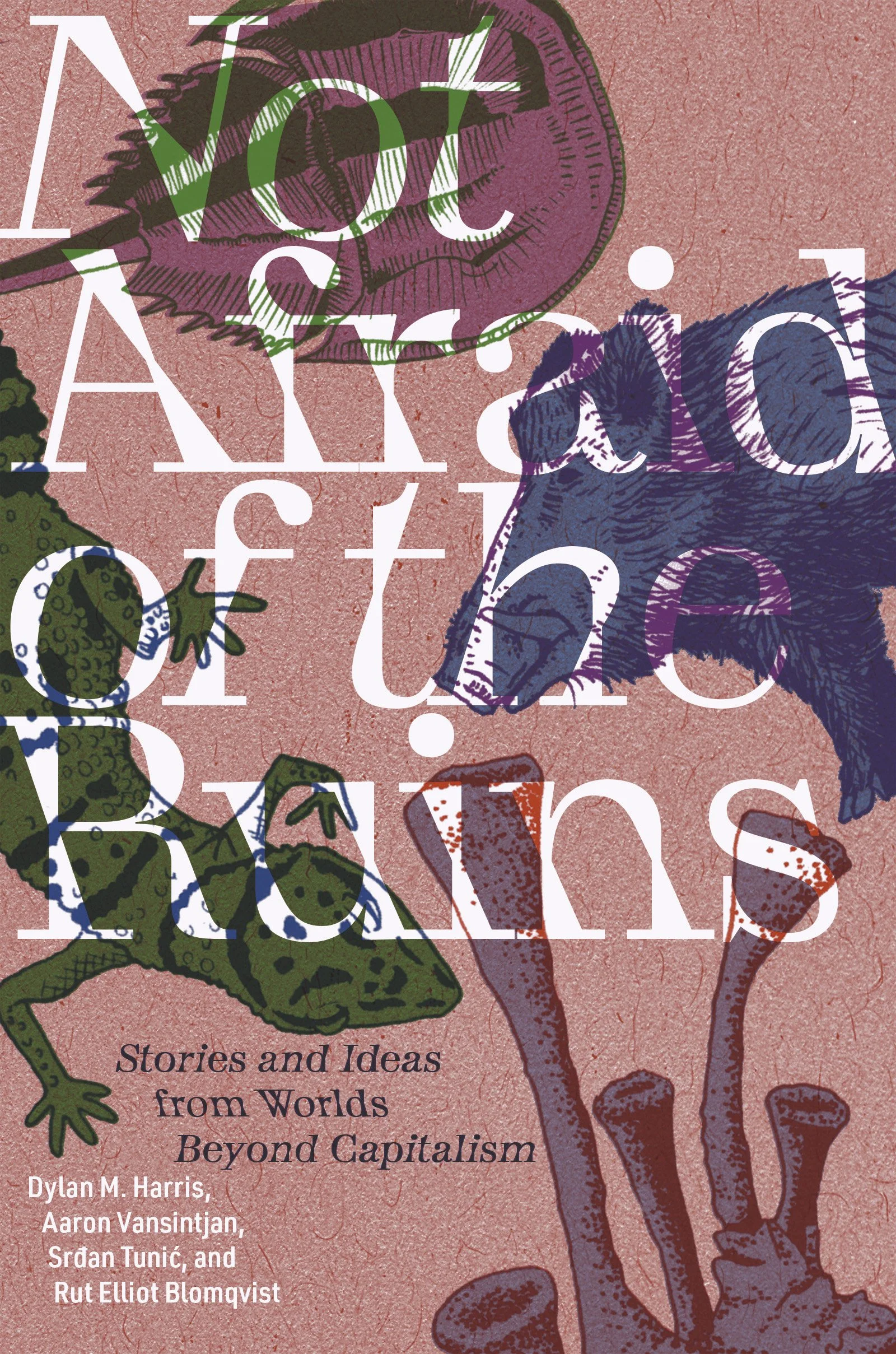
Not Afraid of the Ruins: Stories and Ideas from Worlds Beyond Capitalism
Forthcoming, ships June 2027
Edited by Dylan M. Harris, Aaron Vansintjan, Srđan Tunić, Rut Elliot Blomqvist
“We are not in the least afraid of ruins. We are going to inherit the earth; there is not the slightest doubt about that.”—Buenaventura Durruti
A visionary anthology of speculative fiction imagining ecological survival and radical new worlds beyond the ruins of today.
Amid ecological collapse, mass displacement, and deepening inequality, amongst the greatest consolidation of wealth and power ever, there is a vested interest in convincing us there is no alternative. This collection challenges that anticipatory despair, offering stories and visions that reveal other futures already emerging from the cracks of the present.
Bringing together a diverse cast of contributors, Not Afraid of the Ruins invites readers on a journey from the known to the unknown. An unlikely troupe of companions guides the reader through unsettling, inventive, and deeply human worlds: a boar, a horseshoe crab, a gecko, and a pixie cup lichen. Each offers their unique advice and insights, helping visitors to these future worlds persist and think beyond ruination.
The stories in this anthology fearlessly explore worlds, big and small, shaped by solidarity, ecological renewal, collective liberation, and forms of life beyond extraction and domination. They aptly demonstrate that imagination is not an escape from struggle—it is one of the tools we need to transform the world.
A powerful antidote to political despair, Not Afraid of the Ruins invites us to dream differently, build collectively, and imagine a world before, after, and regardless of capitalism.
Product Details
ISBN: 9781945335921
Published: June 15, 2027
Format: Paperback
Size: 5.5 x 8.5 in
Page count: 256
-
The book’s four editors (from the US, Canada, Serbia, and Sweden) are all connected to the Uneven Earth project and draw from critical theory, queer theory, postmodern, poststructuralist, and revolutionary thinkers and writers to conceive of ways that life will—always has—existed at the margins of capitalism, showing its cracks and limitations. For this project, they have collected stories, poems, and essays that help us imagine what a postcapitalist and decolonial world could look like.
-
Foreword: Storytelling Beyond the Ruins
Ayesha Vemuri & Burç KöstemPreface: A Note About Where to Start
Companion profiles
Map
The Time That Is Given Us
Rut Elliot Blomqvist
Dreaming Spaces
Zareen Pervez Bharucha
Odetta, Odessa
Dylan M. Harris
Krishna Never Looks Up
Harshvardhan Siddharthan
Networked
Srđan Tunić
The Founding of New Crockett, Texas
Nancy Jane Moore
The Technical Assistant
Alex Liebman
The Vine Underground
Anya Verkamp
Waterways
Mel Evans
Fish Out of Water
Mario Reinaldo Machado
Last Stand on Ménez Hom
Enora Mercier
Superglue
Srđan Miljević
The Craven Mode of Production
Rik Janssen
Metamphynus Baalis
Iliana Vargas
Library
Kim Goldberg
Afterword
Seraj Assi
Fiction / Anticolonial Politics
Nonaligned
A Palestinian novel about witnessing a massacre, and worse still, surviving it.
Resurrected in Heaven, a bewildered survivor of a massacre flashes back to harrowing events unfolding in an unnamed besieged town, a camp ravished by hunger and swollen with displaced people and starving children, where a hopeful euphoria building at a breadline culminates in a tragedy and bleak dissolution. Centered on the theme of hunger, the essence of bread, and the magic of flour in a place on the brink of mass starvation, Red Flour is essentially a love story that takes place in a breadline. “But can love blossom in a place ravished by hunger?”
Languishing under an unending siege and constant bombardment, the camp soon dwindles into a necropolis where bone-thin children wither away in the arms of hapless parents, dying a most agonizing death, before being loaded hurriedly into waiting wagons and buried in haste. And beyond starvation a flour massacre unfolds, leading to the protagonist’s cry: “Even our bread is massacred, murdered before it’s leavened.”
This is a compelling story of death and survival, of bread and roses, in a world in which humanity is at a brink.