
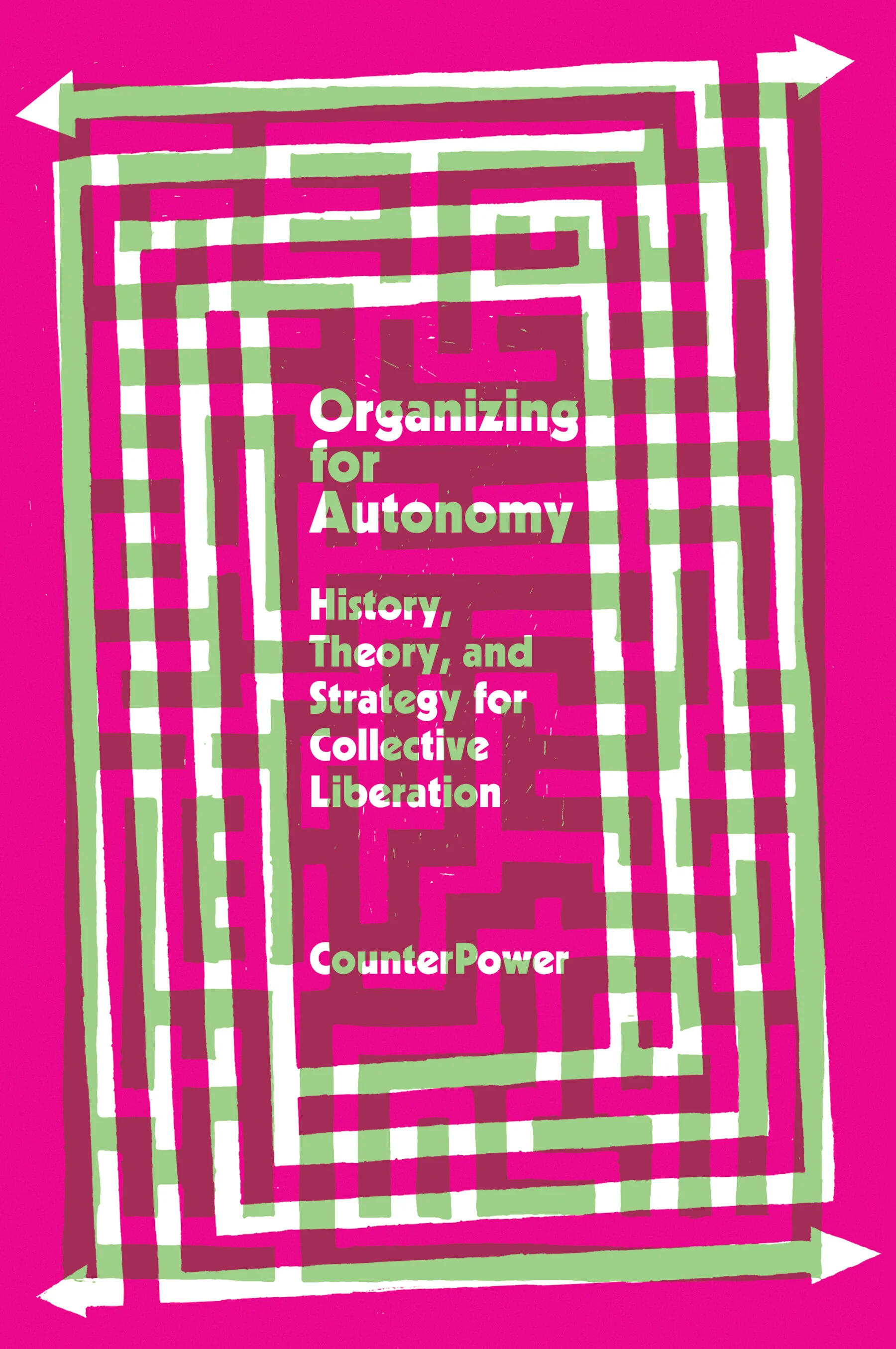
Organizing for Autonomy: History, Theory, and Strategy for Collective Liberation

Organizing for Autonomy: History, Theory, and Strategy for Collective Liberation
CounterPower
Social Movements / Organizing / Philosophy
Organizing for Autonomy takes on the urgent task of critically clarifying and contextualizing a multitude of possibilities, spaces, and opportunities to resist capitalism, climate catastrophe, heteropatriarchy, white supremacy, workers’ exploitation, and a range of other oppressive structures. Delineating the mechanisms of these violent institutions paired with a historical account of revolutionary movements from around the world, and ending with a radical reimagining of contemporary life, CounterPower offers a brazen and determined articulation of a world that centers community, love, and justice.
With unparalleled breadth and synthesizing innumerable sources of revolutionary thought and history into a single vision, Organizing for Autonomy is the result of years of struggle and resistance that acts as both an introduction to revolutionary theory and a practical prompt to the burning questions of how we get free. Bold, fearless, and radically original, Organizing for Autonomy imagines a decolonized, communist, alternative world order that is free from oppressive structures, state violence, and racial capitalism.
Product Details
ISBN: 9781942173212
Published: October 2020
Format: Paperback
Size: 5.5 x 8.5 in
Page count: 240
Other Formats
ISBN: 9781942173397
Format: EPUB
Organizing for Autonomy takes on the urgent task of critically clarifying and contextualizing a multitude of possibilities, spaces, and opportunities to resist capitalism, climate catastrophe, heteropatriarchy, white supremacy, workers’ exploitation, and a range of other oppressive structures. Delineating the mechanisms of these violent institutions paired with a historical account of revolutionary movements from around the world, and ending with a radical reimagining of contemporary life, CounterPower offers a brazen and determined articulation of a world that centers community, love, and justice.
With unparalleled breadth and synthesizing innumerable sources of revolutionary thought and history into a single vision, Organizing for Autonomy is the result of years of struggle and resistance that acts as both an introduction to revolutionary theory and a practical prompt to the burning questions of how we get free. Bold, fearless, and radically original, Organizing for Autonomy imagines a decolonized, communist, alternative world order that is free from oppressive structures, state violence, and racial capitalism.
-
“The old world is collapsing all around us, and communism is in the air. Organizing for Autonomy asks us to breathe deeply of that air, to stand shoulder-to-shoulder with our comrades, and to plot the way forward together. Its cohesive analysis and ambitious vision point toward the North Star and offer a militant strategy for how to get going. It is not a roadmap to the new world, but no matter. After all, communism is not the destination, it is the path itself.”—Geo Maher (George Ciccariello-Maher), author of Spirals of Revolt,Building the Commune, and Decolonizing Dialectics
“CounterPower/ContraPoder offers a deeply thoughtful analysis that is rooted in people's everyday struggles to end oppression. At a time when the criminal failures of capitalism endanger the entire planet, Organizing for Autonomy is rich with revolutionary possibility.” —Barbara Smith, cofounder of the Combahee River Collective and Kitchen Table: Women of Color Press
“Capitalism got us into this mess. Organizing for Autonomy advances the conversation about how we can achieve a different—and better—way of living, in a world without bosses.” —Steve Wright, author of Storming Heaven: Class Composition and Struggle in Italian Autonomist Marxism
“In the new phase of history, and of struggles, which is opening up now, it’s essential to keep alive the link with the history of the Left, and to sum this up critically as a guide to future practice. Organizing for Autonomy is a great contribution to that task. That the capitalist system and its political apparatus are degenerate and parasitic, founded on a racist-imperialist infrastructure, has been true for a long time. But now, suddenly the COVID-19 crisis and racist killings have exposed these realities in exceptional and unprecedented ways. It’s clear that the people's only means of survival is to generate new structures of militance and of care, emerging from within communities themselves, which can become modules of a just social order. The tools proposed in these pages—notably social investigations—are exactly the methods which can be explored in this historic cause. CounterPower offer us an important and extremely topical publication to further our struggle.” —Robert Biel, author of The New Imperialism and The Entropy of Capitalism
-
How can we get free? How can we free ourselves, our communities, our environments, our societies? And what will this freedom look like? While the present moment holds incredible possibilities to organize for our collective liberation, there are powerful forces readily willing and able to summon all available weapons of repression to contain and suppress revolutionary movements. Our present civilization, argued Herbert Marcuse, always must defend itself “against the specter of a world which could be free.”[1] It is our task to give this specter an earthly form.
The question of freedom is central to all revolutionary movements. It is at the root of everyday struggles against white supremacist colonialism, heteropatriarchy, capitalism, the authoritarian state, and every other form of systemic oppression. But we have to ask, again, what will freedom look like? Often, the realities we each face constrain the ways we can answer this question, so we ask it in pieces: How do we provide for each other? How do we protect, nurture, care, love, and create? How do we liberate ourselves from the hardships of enclosure, exploitation, and dependency that are imposed on our minds, bodies, communities, and environments? How do we free our sense of freedom, so that it is not a set of individual and extractive privileges, but is instead the grounding for a communal form of abundance?
Where we stand today is the result of centuries of struggle between forces of liberation and forces of domination. Governments and corporations pour toxins into bodies, minds, and environments, creating an unsustainable world of individualism, disposability, and extraction that festers with antiblack, heteropatriarchal, and settler-colonial violence. The powers that structure our “civilization” have brought the entire planetary system to the precipice of ecological collapse, while at the same time preparing the ground for resurgent forms of fascism that exploit ordinary people’s frustrations by fragmenting the oppressed with xenophobic and antiblack sentiments. Imperialism—justified under the guise of multiculturalism and sustainable development—now increasingly must contend with forms of right-wing nationalism and white supremacy promoting a vision of the future in which outsiders of any sort are walled off by frightened and insecure attempts to recreate a mythic past of white, heteropatriarchal bliss.
As an individual, it can seem almost impossible to confront such massive forces of global devastation and reactionary violence. In isolation from one another, as individualized consumers, workers, voters, and families, it is easy for avoidance and apathy to close in and keep us from seeing that, together, side-by-side, we can turn our faces toward the storm.
“Revolutions are made not to get more (or, of course, less) of what we already have,” André Gorz reminds us, “but to get something altogether different which will put an end to conditions that are felt to be unbearable.”[2] The aim of social revolution is to succeed in creating a different way of life, one that can liberate the immense creative potential of a humanity united in its diversity. Social revolution aims to nurture new sensibilities about how life can and should be lived, and to establish the conditions for their flourishing. Social revolution is not just seizing power or tearing down the system, it is a passage between worlds.[3] We need analyses, visions, and strategies to guide us from this world to the next, based on an honest assessment of the material realities we face. Our values—freedom, equality, autonomy, solidarity—and the histories of struggle past and present, can help us chart a path toward liberation.
[1] Herbert Marcuse, Eros and Civilization: A Philosophical Inquiry into Freud (New York: Vintage Books, 1962), 85.
[2] André Gorz, Socialism and Revolution (London: Allen Lane, 1975), 11.
[3] Georges Fontenis, “Manifesto of Libertarian Communism (1953),” The Anarchist Library, https://theanarchistlibrary.org/library/georges-fontenis-manifesto-of-libertarian-communism.pdf/.
-
CounterPower is a revolutionary organization committed to building the power of working and oppressed people, from below and to the left. Drawing lessons from past and present movements, we offer an analysis, vision, and strategy to build for social revolution in the heart of empire. We organize to dismantle the imperialist world-system: a system based on the fusion of capitalism, heteropatriarchy, white supremacy, and the state. This system is killing people and the planet. In its place, we want to build a free society where all people have full control over their lives. Revolutionary movements must build the “counterpower” necessary to overthrow and abolish all forms of oppression. We believe that autonomous organizations, from labor and tenant unions to councils and communes, are necessary to advance the struggle for liberation. With branches throughout the United States, CounterPower has more than a decade of experience helping to build the collective power and autonomy of workers and the oppressed. As comrades, we work together to build and practice revolutionary politics in our grassroots organizing, embodying the values of a free society in the present. We care for one another as we work to transform ourselves and the world around us.


Forthcoming, ships November 2026
Edited by Carla Orendorff, Anthony Orendorff, Lupita Limon Corrales, Ananya Roy, and Marisa Lemorande
Preface by Robin D. G. Kelley
Urban Studies / Health & Care / Organizing
Written by unhoused people and their allies, We Live in Public is an invitation to revolutionary care in a time of class war.
Los Angeles is one of the richest and most unequal cities in the world, where nine unhoused people die every day. As rent rises, evictions increase, and houselessness grows, the homeless encampment becomes both a symptom of organized abandonment and a site of insurgent knowledge and practice. We Live in Public was conceptualized and written by residents and organizers of one such encampment, Aetna Street, whose experiences offer strategies for solidarity and survival in the face of escalating state violence.
Many people’s worst fear is to be homeless, equating it with social death. But within the encampment, we see people living with wisdom and maps to offer. Throughout this book, Aetna residents and organizers generously share such insights and analysis. We Live in Public insists that these histories provide crucial lessons in modes of collective living and must be at the center of public history and knowledge.
Centering those who care for others on the street, it is an invitation to revolutionary care in the time of war. That war is the more immediate criminalization of homelessness and the longer arc of the unrelenting settlement of the US. We Live in Public is a refusal of such settler-colonial logics in the making of home and place.