
The Wretched of the Earth Want the Fall of the System: A Critical Consideration of Neocolonialism and Its Dismantling
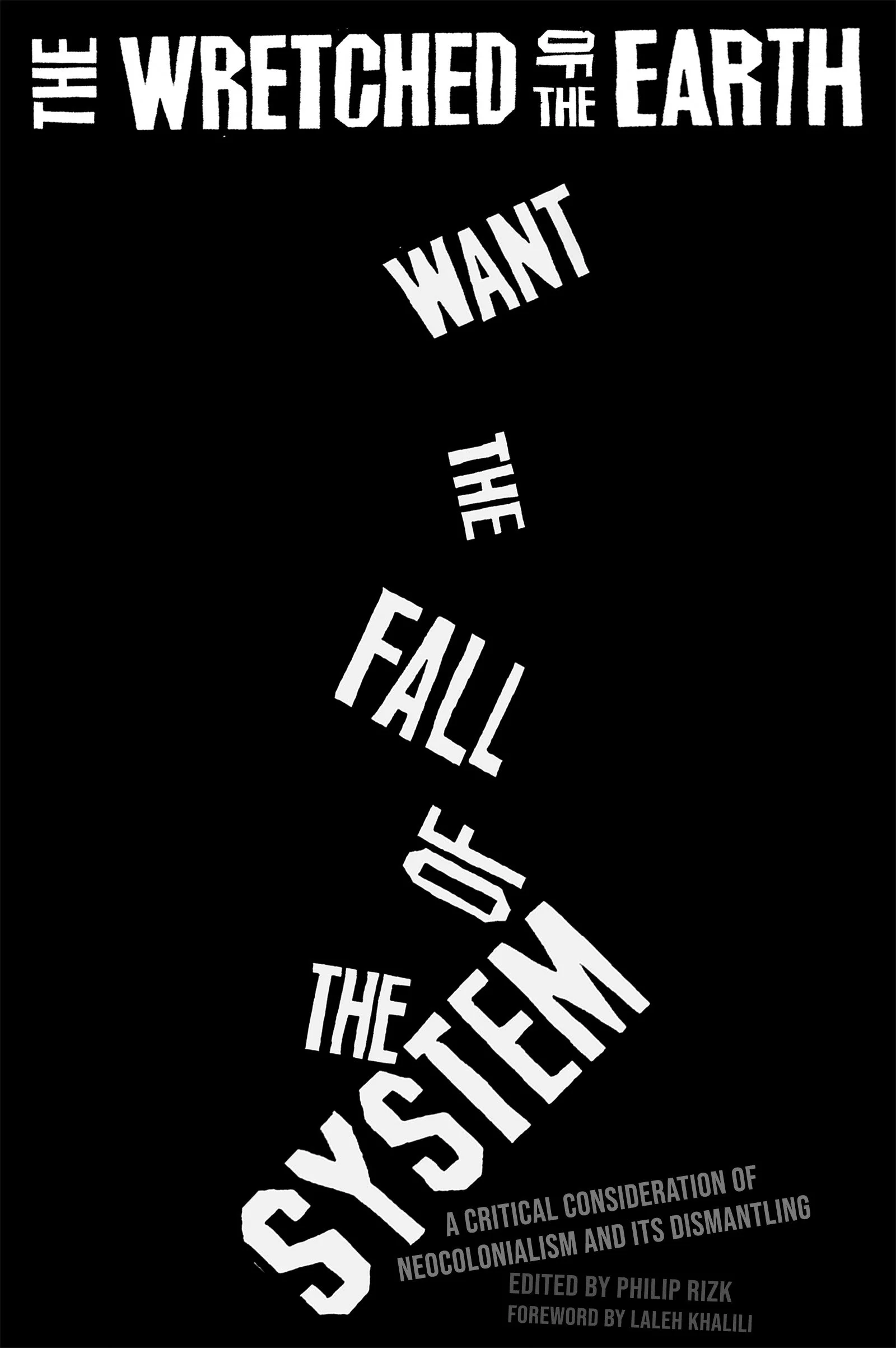
The Wretched of the Earth Want the Fall of the System: A Critical Consideration of Neocolonialism and Its Dismantling
Forthcoming, ships July 2027
Edited by Philip Rizk
Foreword by Laleh Khalili
Anticolonial Politics
Nonaligned
A critical re-reading of Frantz Fanon’s The Wretched of the Earth by activists and thinkers from the Arabic-speaking region.
More than sixty years after the publication of The Wretched of the Earth, Frantz Fanon's revolutionary analysis illuminates the structures of domination that shape the present. But what does Fanon reveal when read from the front lines of today's struggles in the very region he was radicalized in?
The Wretched of the Earth Want the Fall of the System brings together activists, organizers, and critical thinkers from across the Arabic-speaking region and its diaspora to place Fanon's landmark work in conversation with contemporary movements challenging authoritarianism, occupation, and neocolonial rule. They argue that while formal colonialism has often given way to neocolonial forms of power, the logic of colonial domination persists. Fanon's analysis remains indispensable for identifying these evolving structures—and for imagining how they can be dismantled.
Essential reading for activists, students, and anyone seeking to understand the unfinished project of decolonization in the Arab-speaking region, this timely and compelling book demonstrates why Fanon's work remains one of the most vital guides to revolutionary transformation in the twenty-first century.
Product Details
ISBN: 9781945335938
Published: July 27, 2027
Format: Paperback
Size: 6 x 9 in
Page count: 272
-
Philip Rizk is a filmmaker and writer from Cairo currently living in Berlin. In his films, he experiments with methods of “making the habitual strange.” He does this through performance in Out on the Street (2015) codirected with Jasmina Metwaly, and in his found-footage films Mapping Lessons (2020) and Terror Tales (2024), Rizk experiments with the technique of montage. Along with the filmmaker Baya Medhaffer, he is programming the upcoming Majliss Fanon, a film program around Frantz Fanon’s Wretched of the Earth, and is editor of the upcoming book Neocolonialism and its Dismantling, which puts Fanon’s final book in conversation with the revolutions of the Arabic-speaking region in the past fifteen years.
-
Foreword – Laleh Khalili
Introduction – Philip Rizk
PART I
1. burying Fanon (poem) – Mona Kareem
2. Cause a Ripe Fruit to Burst Forth: A gaze on the neocolonial present and its dismantling – Philip Rizk
3. The Kabyle Mentality (1951) – Mohamed Sail
4. Introduction to Mahdi Amel's reading of Frantz Fanon – Ziad Kiblawi
5. The Revolutionary Thought of Frantz Fanon – Mahdi Amel
6. The Temporal Entanglements of Assia Djebar’s The Zerda or the Songs of Forgetting – Philip Rizk
7. The Zerda or the Songs of Forgetting – Assia Djebar
8. Hopeful Pathologies in the War for Palestine: a reply to Adam Shatz – Abdeljawwad OmarPART II
9. latent lilies (poem) introduced & translated by Jessica Khazrik – Omnia Sabry
10. The Sea is Angry – Raghed Yousef
11. Generals to the Dustbin, Algeria will be Independent – Hamza Hamouchene
12. The Realization of People’s Sovereignty: Sudan’s Neighborhood Councils – Muzan Alneel
13. “Let us eradicate from our land and minds the seeds of neocolonial decay”: On agroecology as a strategy for dismantling (neo)colonialism – Salem Al-Azouaq, Lina Ismail, and Hadi Awada w/ Philip Rizk
14. Kafala After Fanon – Sumayya Kassamali
15. The Principle of Return – Adam HajYahiaAPPENDIX
16. 1963 Editors’s Preface to Muadhibu al-ard (The Wretched of the Earth)
Seraj Assi
Fiction / Anticolonial Politics
Nonaligned
A Palestinian novel about witnessing a massacre, and worse still, surviving it.
Resurrected in Heaven, a bewildered survivor of a massacre flashes back to harrowing events unfolding in an unnamed besieged town, a camp ravished by hunger and swollen with displaced people and starving children, where a hopeful euphoria building at a breadline culminates in a tragedy and bleak dissolution. Centered on the theme of hunger, the essence of bread, and the magic of flour in a place on the brink of mass starvation, Red Flour is essentially a love story that takes place in a breadline. “But can love blossom in a place ravished by hunger?”
Languishing under an unending siege and constant bombardment, the camp soon dwindles into a necropolis where bone-thin children wither away in the arms of hapless parents, dying a most agonizing death, before being loaded hurriedly into waiting wagons and buried in haste. And beyond starvation a flour massacre unfolds, leading to the protagonist’s cry: “Even our bread is massacred, murdered before it’s leavened.”
This is a compelling story of death and survival, of bread and roses, in a world in which humanity is at a brink.