
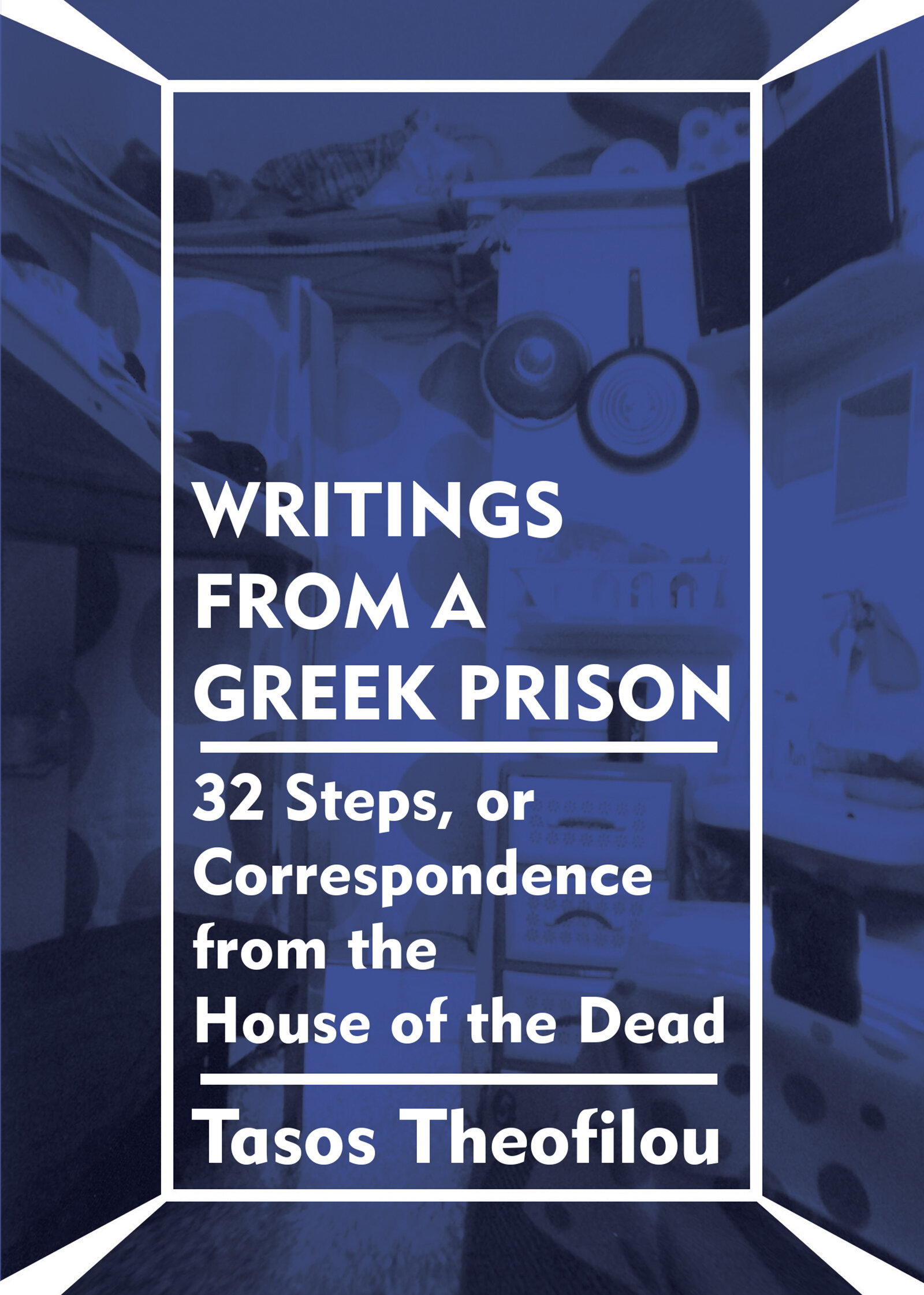
Writings from a Greek Prison: 32 Steps, or Correspondence from the House of the Dead

Writings from a Greek Prison: 32 Steps, or Correspondence from the House of the Dead
Tasos Theofilou
Translated by Eleni Pappa
Preface by Ben Morea
Writings from a Greek Prison is a literary work of biting realism. Tasos Theofilou gives testimony on the brutality of prison life, and its centrality in contemporary capitalism, through a blur of memoir, social commentary, free verse, and a glossary of the idiom used by inmates in Greek prisons.
A political prisoner in Greece from 2012 to 2017, Theofilou’s work centers on exposing the conditions of widespread exploitation and social struggle that persist in Greece as a result of the debt crisis—in prisons as well as in mainstream society. Common Notions’ new imprint, ΔΙΠΛΗ / DIPLI, taking its name from the Greek word “double,” refers to the way in which prisoners from different prisons communicate by way of the double telephone line. With this strategy, two to five prisoners in different locations call the same telephone number at an agreed upon time and the owner of that telephone number, living outside prison, connects them together. Proceeds raised through the DIPLI imprint will support political prisoners.
ΔΙΠΛΗ / DIPLI imprint
Product Details
ISBN: 9781942173120
Published: May 2019
Format: Paperback
Size: 5 x 7 in
Page count: 144
Other Formats
ISBN: 9781942173311
Format: EPUB
Writings from a Greek Prison is a literary work of biting realism. Tasos Theofilou gives testimony on the brutality of prison life, and its centrality in contemporary capitalism, through a blur of memoir, social commentary, free verse, and a glossary of the idiom used by inmates in Greek prisons.
A political prisoner in Greece from 2012 to 2017, Theofilou’s work centers on exposing the conditions of widespread exploitation and social struggle that persist in Greece as a result of the debt crisis—in prisons as well as in mainstream society. Common Notions’ new imprint, ΔΙΠΛΗ / DIPLI, taking its name from the Greek word “double,” refers to the way in which prisoners from different prisons communicate by way of the double telephone line. With this strategy, two to five prisoners in different locations call the same telephone number at an agreed upon time and the owner of that telephone number, living outside prison, connects them together. Proceeds raised through the DIPLI imprint will support political prisoners.
-
“Tasos Theofilou’s intervention sheds light on one of the most observed periods of contemporary Greek history through the eyes of an anarcho-communist militant who suddenly found himself charged (and imprisoned for 5 years) for a crime many, and above all his prosecutors, knew he had not committed. Combining wit and scathing social criticism, the book is a documentation, a damning testament, a literary expression, and a glossary written from the perspective of an inmate. But it is not confined to Tasos’ own experience. It unveils the repressive mechanism of class domination that is the same all around the world: the prison system. It is, for this reason, an indispensable testimony of a world everyone knows exists but few pay attention to. Above all, it is an unwavering call for its abolition.” —Pavlos Roufos, author of A Happy Future Is a Thing of the Past
-
Tasos Theofliou is an anarchist-communist and political prisoner in Greece, from 2012 to 2017. He is the author of six books in Greece, as well as Writings from a Greek Prison with Common Notions. Through speculative fiction, noir, and graphic novel genres, he illuminates the conditions of exploitation and social conflict in Greece. While in prison, Theofilou also authored a book on Attica as part of the international solidarity with the U.S. prisoners’ strike on the forty-fifth anniversary of the prison uprising.
Theofilou's Address to the Court of Appeal
Theofilou addressed the Court of Appeal on April 28, 2017 with the following statement in his plea:
“My prosecution is part of a comprehensive effort by the Greek political personnel to introduce, implement, and enforce a Law and Order doctrine over the past two and a half decades—an effort which has intensified from 2009–2015. This is a doctrine that entwines the Ministry of Public Order and the Ministry of Justice and is imported by the Greek government as a policy package from the United States.
I repeat once again, and conclude, that I did not commit the offenses for which I am accused. I did commit, however, the one offense that includes all others. I am an anarchist. In the class war, I chose the side of the excluded and the underprivileged, the prosecuted and the accursed, the poor, the weak, and the oppressed.
My imprisonment is, on the one hand, the only natural consequence of that choice, and on the other hand, one more field of struggle.”
-
ΔΙΠΛΗ [DIPLI] is a Common Notions imprint on social cannibalism. Funds raised go to political prisoners.
ΔΙΠΛΗ [DIPLI (/dip’li/): literally: double (from Greek)]: The double telephone line is the way prisoners from different prisons communicate. Two to five prisoners from different prisons call the same telephone number at an arranged time. The owner of that telephone number, living outside prison, connects them together.
Social cannibalism is the situation in which people, individually or in small groups, oppress and exploit others in their immediate social enviroment and within the limits of their daily action. The most powerful ones attack directly the weakest with any manifestation of domination, authority or influence; the lowest level of individualism and of a fragmented society. Social cannibalism does not manifest itself immediately and completely but develops incrementally. It is the zero point of counter-revolution from below (hierarchies, divisions, manipulations), as war is the zero point of counter-revolution from above (repression, assimilation, mediation). The term social cannibalism is used by anarchists in Greece after the robbery and murder of a man in Athens (Manolis Kantaris, 9/5/2011). Golden Dawn exploited that incident to do a pogrom against immigrants (10–12/5/2011) that led to the killing of one (Alim Abdul Manan, 12/5/2011). The term social cannibalism caught; a contradiction—people that denounce violence accept it against those separated from them when executed by those connected to them; a pattern—parts of the proletariat face off against one another by turning oppression on oneself into stigmatization of the other; the context of EU/ECB/IMF memoranda—the Greek-Government Debt Crisis/Eurozone Crisis is homogenized according to nationality and moralized, internalized into guilt of one's worth as a person through the relationship between self and other, the shared representations of action, emotions, and the body. To publish on social cannibalism is to account for both the previous cycle of struggle in Greece—the defeat of the anti-memorandum mobilizations (2010/12)—and the global capitalist restructuring today.
dipli@espiv.net
dipli.espivblogs.net


Abolition Journal Working Group
Abolition / Black Liberation
The inaugural issue of the movement-focused and future-forward Abolition Journal quarterly after it was relaunched by the Philadelphia-based Abolition School.
This pilot issue of the revived Abolition Journal is produced by the Philadelphia-based W.E.B. Du Bois Movement School for Abolition & Reconstruction. It brings together two dozen urgent and timely interventions in political debates around abolition and aims to show how this abstract idea manifests itself in our daily lives.
These interventions, authored by a diverse cast of contributors, including academics and attorneys, so-called felons and physicians, artists and educators, and parents, playwrights and poets, explore the everyday experiences that come with trying to live out an abolitionist politics. In the words of the editors, these experiences include “the daily victories and errands, reflections and runarounds, gestures and drama, habits and heartbreaks, setbacks and surrenders, excuses and evasions, breakdowns and breakthroughs.”
The issue curates a variety of content, including political essays, short stories, poetry, interviews, and speeches, each resonating and reflecting in their own unique way on the central theme “Everyday Sh!t.” They offer thoughts and reflections on structure, practice, care, and direction to deepen existing movement knowledge and invite new audiences to see themselves mirrored within this work.
Without exception, these are stories of sincere experience mixed with radical poetic visions culled from the issue contributors’ plurality of pasts, presents, and prefigurative futures. Grounded in Philadelphia, yet looking out onto the whole wide world, Abolition Journal aims to reflect the lived complexity that can be messy and self-defeating, but equally authentic and inspiring.