
Echoes of the Water War: Legacies of Cochabamba, Bolivia
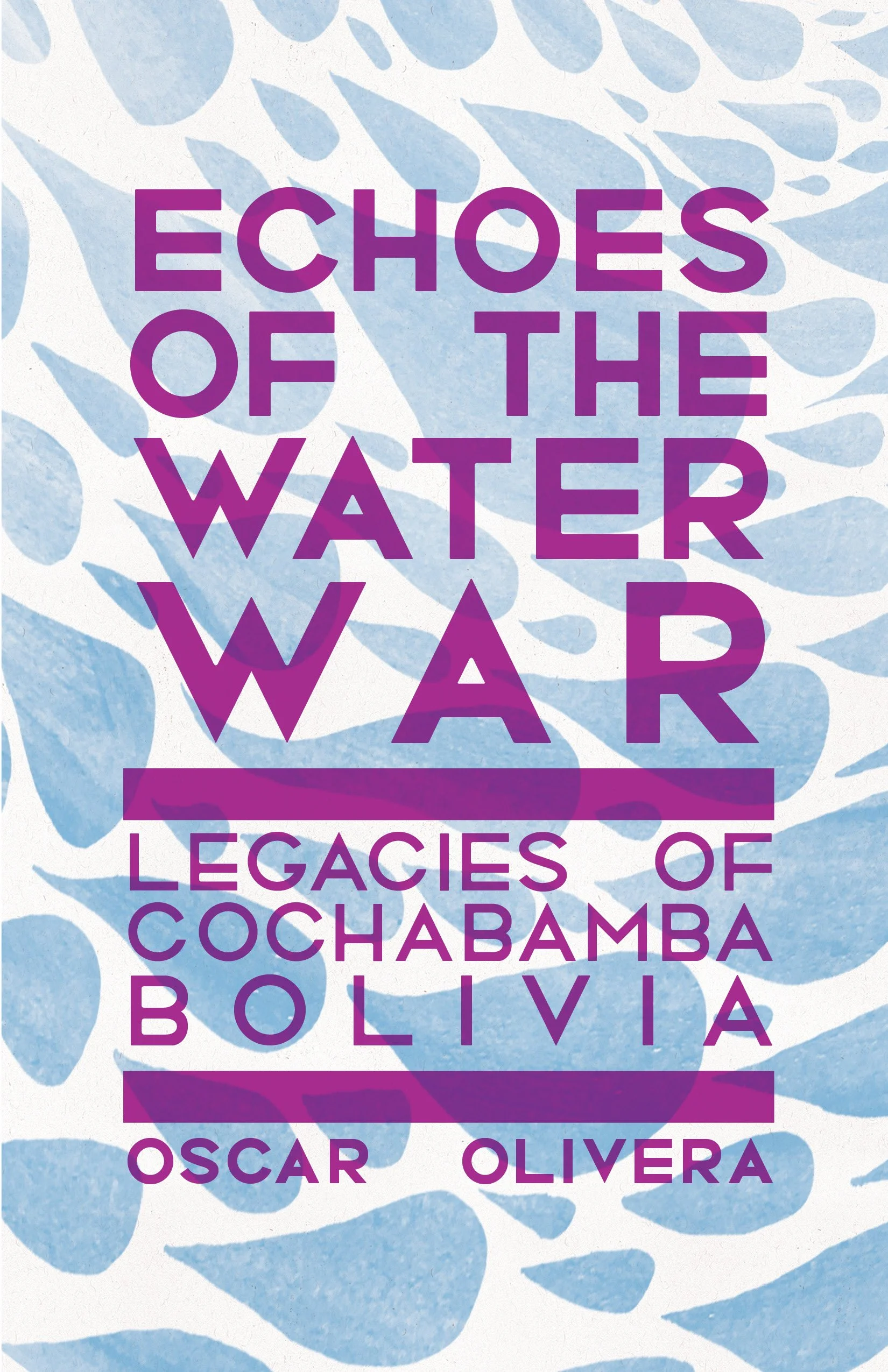
Echoes of the Water War: Legacies of Cochabamba, Bolivia
Oscar Olivera
Prologue by Raquel Gutiérrez Aguilar
With Contributions by Raul Zibechi, Massimiliano Tomba, Nelly Perez, Marcela Olivera, Stefano Archidiacono, and Alexander Dwinell
Ecology / Latin America / Social Movements
Lessons from one of the greatest people’s victories against corporate neoliberal capture.
Water is life! From the frontlines of one of the greatest popular rebellions against the privatization of natural resources comes the triumphant grassroots struggle that transformed ordinary people into water warriors. The “water wars” in Cochabamba, Bolivia between December 1999 and April 2000 were a series of protracted struggles for direct democracy and defense of the commons, which won popular control of water supply and defied all odds by driving out the transnational corporation that had stolen their water in the first place.
Oscar Olivera, a trade union machinist who helped shape and lead a movement that brought thousands of people to the streets, powerfully conveys the perspective of a committed participant in a victorious and inspirational rebellion. Alongside Olivera’s hard-won political savvy, Echoes of the Water War presents leading voices on Latin American movements, including Raquel Gutiérrez Aguilar, Massimiliano Tomba, Raul Zibechi, Marcela Olivera, Stefano Archidiacono, and Alexander Dwinell. Together they reflect on major themes that emerged from the battle over water: the fear and isolation that Cochabambans faced with a spirit of solidarity and mutual aid; the challenges of democratically administering the city’s water supply; the impact of the water wars on subsequent resistance, and its legacies twenty-five years later.
Echoes of the Water War brings us to the heart of a movement, chronicling how the people organized an opposition and the dramatic struggles that eventually defeated the privatizers. Twenty-five years later, Cochabamba teaches us that the real issue is not the capture of state power, but the creation of new commons from the grassroots up and with it, the capacity to govern ourselves.
Product Details
ISBN: 9781945335297
Published: April 22, 2025
Format: Paperback
Size: 5 x 8 in
Page count: 208
Other Formats
ISBN: 9781945335525
Format: EPUB

Lessons from the greatest people’s victory against corporate neoliberal capture in Latin America.
Water is life! From the frontlines of the greatest popular rebellion against the privatization of water comes the triumphant grassroots story of ordinary people in Cochabamba, Bolivia who became water warriors. As Echoes of Cochabamba shows in vivid detail, the 2001 “water wars” was an explosion of democracy and human rights regained by the masses, which won popular control of water supply and defied all odds by driving out the transnational corporation that had stolen their water in the first place.
Oscar Olivera, a trade union machinist who helped shape and lead a movement that brought thousands of ordinary people to the streets, powerfully conveys the perspective of a committed participant in a victorious and inspirational rebellion.
Olivera relates the selling of the city’s water supply to Aguas del Tunari—a subsidiary of US-based Bechtel—the subsequent astronomical rise in water prices, and the refusal of poverty-strapped Bolivians to pay them. Olivera brings us to the front lines of a movement, chronicling how the people organized an opposition and the dramatic struggles that eventually defeated the privatizers.
With hard-won political savvy, Olivera reflects on major themes that emerged from the war over water: the fear and isolation that Cochabambinos faced with a spirit of solidarity and mutual aid; the challenges of democratically administering the city’s water supply; and the impact of the water wars on subsequent resistance.
Twenty-five years later, Cochabamba teaches us that the real issue is not the capture of state power, but the creation of new pathways from the grassroots up.
-
“A valuable contribution to the insights and lessons to be learned from the struggles against neoliberal onslaughts, especially given Bolivia’s current political context.” —Green Left
“This book is a gift to a new generation of English-reading activists, students, and concerned people around the world. May we learn from the lessons Olivera and the other authors take from the Water War and its aftermath: the importance of maintaining social movements’ independence, building solidarity across differences and geography, binding our future to the wellbeing of the rest of nature, and creating the world we want in the here and now as we confront authoritarianism and environmental crisis by building and fortifying organizations rooted in community and environmental justice.” —Sarah T. Hines for NACLA
-
Oscar Olivera, then Executive Secretary of the Federation of Factory Workers of Cochabamba, Bolivia (1999), actively participated in creating the Coordinadora de Defensa del Agua y de la Vida, a key organization in the movement against water privatization in Bolivia and Cochabamba in 2000. He is recipient of the Letelier-Moffitt Human Rights Award (2000), the Goldman Environmental Prize (2001), the James Lawson Award for nonviolent activism (2013) as well as numerous recognitions from rural and urban organizations in Bolivia.
Raquel Gutiérrez Aguilar is an organizer who has participated in numerous struggles and uprisings in Latin America over the last four decades. From the civil wars in Central America in the 1980s to Indigenous-led uprisings in the Bolivian altiplano, she has contributed to struggles both as an active participant and as a theorist of movement strategies, horizons, and possibilities. She is the author of In Defense of Common Life.
Raul Zibechi is a radio and print journalist, writer, militant and political theorist. He has contributed to the weekly newspaper Brecha. He is author of Constructing Worlds Otherwise.
Massimiliano Tomba’s work focuses on time and temporalities, Marxism, critical theory (especially the first generation of the Frankfurt School), and modern and contemporary political thought. He is author of Insurgent Universality: An Alternative Legacy of Modernity.
Nelly Perez has a degree in Social Communication and Journalism, pro- duces multimedia reports with a social and environmental focus, and she is also an activist that focuses on the revalorization of knowledge and wisdom of the Quechua nation in Bolivia.
Marcela Olivera is a water commons organizer based in Cochabamba, Bolivia. Since 2004 she has been helping to develop and consolidate an inter-American citizens’ network on water justice named Red VIDA. She is also member of the Platform for Public and Community Partnerships of The Americas (PAPC), an organization that promotes knowledge exchange among water utilities based on solidarity and horizontal cooperation.
Stefano Archidiacono is an Italian activist, researcher, and development practitioner.
Alexander Dwinell is an organizer, editor, designer, and artist. He is a former member of the South End Press collective and founding bookseller of The Word Is Change.


Colectivo Situaciones
Latin America / Organizing
Documents the theories, debates, successes, and failures of a rebellious tactic to build popular power.
Genocide in the Neighborhood documents the autonomist practice of the “escrache,” a system of public shaming that emerged in the late 1990s to vindicate the lives of those disappeared under the Argentinean dictatorship and to protest the amnesty granted to perpetrators of the killing. The book is an example of militant research, an investigative method that Colectivo Situaciones has pioneered. Through a series of hypotheses and two sets of interviews, Genocide in the Neighborhood documents the theories, debates, successes, and failures of the escraches—what Whitener provisionally defines as “something between a march, an action or happening, and a public shaming—investigates the nature of rebellion, discusses the value of historical and cultural memory to resistance, and suggests decentralized ways to agitate for justice.
The book follows the popular Argentine uprising in 2001, a period of intense social unrest and political creativity that led to the collapse of government after government. The power that ordinary people developed for themselves in public space soon gave birth to a movement of neighborhoods organizing themselves into hundreds of popular assemblies across the country, the unemployed workers struggle mobilizing, and workers taking over factories and businesses. These events marked a sea change, a before and an after for Argentina that has since resonated around the world. In its wake Genocide in the Neighborhood tactfully deploys a much needed model of political resistance.