
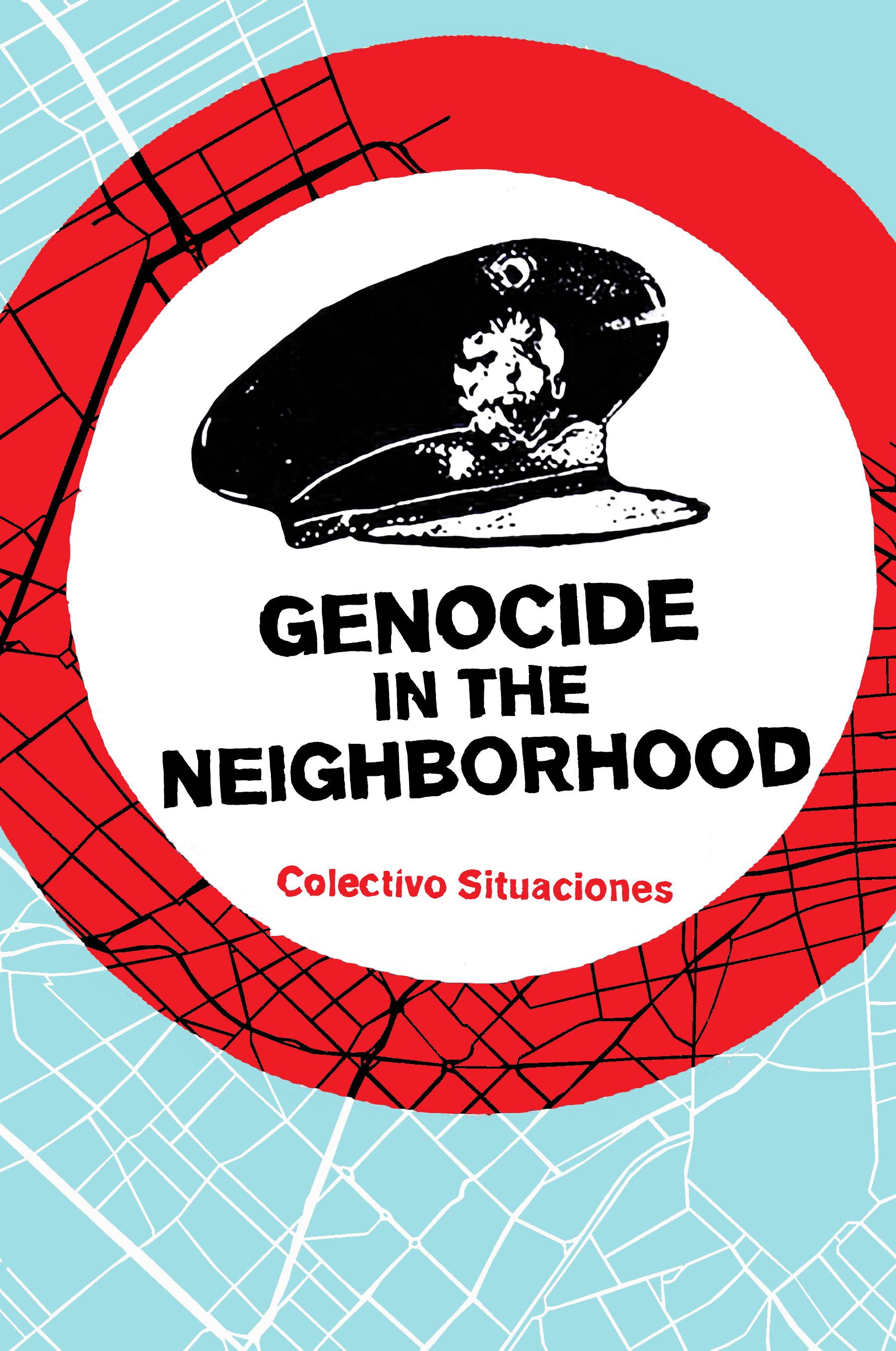
Genocide in the Neighborhood: State Violence, Popular Justice, and the ‘Escrache’

Genocide in the Neighborhood: State Violence, Popular Justice, and the ‘Escrache’
Colectivo Situaciones
Documents the theories, debates, successes, and failures of a rebellious tactic to build popular power.
Genocide in the Neighborhood documents the autonomist practice of the “escrache,” a system of public shaming that emerged in the late 1990s to vindicate the lives of those disappeared under the Argentinean dictatorship and to protest the amnesty granted to perpetrators of the killing. The book is an example of militant research, an investigative method that Colectivo Situaciones has pioneered. Through a series of hypotheses and two sets of interviews, Genocide in the Neighborhood documents the theories, debates, successes, and failures of the escraches—what Whitener provisionally defines as “something between a march, an action or happening, and a public shaming—investigates the nature of rebellion, discusses the value of historical and cultural memory to resistance, and suggests decentralized ways to agitate for justice.
The book follows the popular Argentine uprising in 2001, a period of intense social unrest and political creativity that led to the collapse of government after government. The power that ordinary people developed for themselves in public space soon gave birth to a movement of neighborhoods organizing themselves into hundreds of popular assemblies across the country, the unemployed workers struggle mobilizing, and workers taking over factories and businesses. These events marked a sea change, a before and an after for Argentina that has since resonated around the world. In its wake Genocide in the Neighborhood tactfully deploys a much needed model of political resistance.
PRODUCT DETAILS
ISBN: 9781942173861
Published: December 2023
Format: Paperback
Size: 5 x 8 in
Page count: 160
Other Formats
ISBN: 9781945335020
Format: EPUB
-
“This is a book born in the barricades, neighborhood assemblies, and factory occupations of Argentina’s 2001 uprising against neoliberalism. Written by movement participants, it’s an inspiring account of the rebellion and a grassroots model of how to research and theorize a movement that forged a new way of doing politics from below. The English translation of such a classic book that’s been passed around revolutionary circles for decades is a cause for celebration and hitting the streets!”—Benjamin Dangl, author of The Five Hundred Year Rebellion: Indigenous Movements and the Decolonization of History in Bolivia
“If the insurrection in Argentina that began in December 2001 was our Paris Commune, then Colectivo Situaciones fits well in the position of Karl Marx. As Friedrich Engels was fond of saying, one of Marx’s many talents was to analyze the historical importance of political events as they took place. This book by Colectivo Situaciones, written in the heat of action, certainly demonstrates that same talent in full, delving into the complexity of concrete events while simultaneously stepping back to recognize how our political reality has changed.”—Michael Hardt, coauthor of Empire, Multitude, and Assembly
“This book composes the fragments of a global discourse, finding in the experience of the Argentinean struggle a style of inquiry that emerges directly from the organization of the struggle.”—Antonio Negri, coauthor of Empire, Multitude, and Assembly
-
“Assemblies may become thinking machines. And experiments of resistance may give rise to alternative experiences of sociability. Colectivo Situaciones develops out of these findings, that emerged within the 2001 resurrection in Argentina, a powerful reflexive research: a truly magnificent effort to explore the potentialities of a future beyond capitalism.”—Stavros Stavrides, author of Towards the City of Thresholds
“Twenty years ago, Argentina erupted in blockades and assemblies, occupations, demonstrations, and communal kitchens. In both its circumstances and forms, the 2001 uprising presaged the protests of 2011 and the struggles of our time. Colectivo Situaciones’ 19 & 20 provided both the sharpest analysis of that moment and a model of theoretical practice: nimble, dialogical, embedded in the movements with whom it thought, made in common. To rediscover it today is to do more than reconnect with the recent past; it is inevitably also to ask how it illuminates what we have lived since, and how we can continue to extend its lessons into the future.”—Rodrigo Nunes, author of Neither Vertical Nor Horizontal: A Theory of Political Organization
“A long decade before Occupy Wall Street, Argentineans poured into the streets to reject austerity and short the circuits of neoliberal capitalism, proving that state violence was no match for popular refusal. But this is not a book about Argentina or even Latin America as a whole, a brutal laboratory where neoliberalism was imposed in blood and fire. It's about a way of thinking that is also a doing, about what the concrete experience of rebellion teaches us about how the world moves, and how to turn that movement into thought. Find yourself in this book.”—Geo Maher, author of Building the Commune and A World Without Police
“The 2001 uprising in Argentina is a major flashpoint in a wave of popular struggles that repudiated the neoliberal capitalist order and authored new forms of non-capitalist social construction. Colectivo Situaciones gives us important analyses of the uprising and its legacies, the roots of Argentina’s financial and political crisis, and changes in contemporary forms of anticapitalist mobilization and resistance. Their close attention to grassroots practices of resistance, political organizing, and world-making is emblematic of their method of militant research, which itself has been an inspiration to so many. Those interested in contemporary social movements, political theory, and the history of Argentina and the region will find much to appreciate in this wonderful new edition.” —Jennifer S. Ponce de León, author of Another Aesthetics Is Possible: Arts of Rebellion in the Fourth World War
-
Colectivo Situaciones is a collective of militant researchers based in Buenos Aires, Argentina. They have participated in numerous grassroots coresearch projects with unemployed workers, peasant movements, neighborhood assemblies, and alternative education experiments.


Colectivo Situaciones
Latin America / Organizing
Documents the theories, debates, successes, and failures of a rebellious tactic to build popular power.
Genocide in the Neighborhood documents the autonomist practice of the “escrache,” a system of public shaming that emerged in the late 1990s to vindicate the lives of those disappeared under the Argentinean dictatorship and to protest the amnesty granted to perpetrators of the killing. The book is an example of militant research, an investigative method that Colectivo Situaciones has pioneered. Through a series of hypotheses and two sets of interviews, Genocide in the Neighborhood documents the theories, debates, successes, and failures of the escraches—what Whitener provisionally defines as “something between a march, an action or happening, and a public shaming—investigates the nature of rebellion, discusses the value of historical and cultural memory to resistance, and suggests decentralized ways to agitate for justice.
The book follows the popular Argentine uprising in 2001, a period of intense social unrest and political creativity that led to the collapse of government after government. The power that ordinary people developed for themselves in public space soon gave birth to a movement of neighborhoods organizing themselves into hundreds of popular assemblies across the country, the unemployed workers struggle mobilizing, and workers taking over factories and businesses. These events marked a sea change, a before and an after for Argentina that has since resonated around the world. In its wake Genocide in the Neighborhood tactfully deploys a much needed model of political resistance.