
From Thresholds to Emancipation
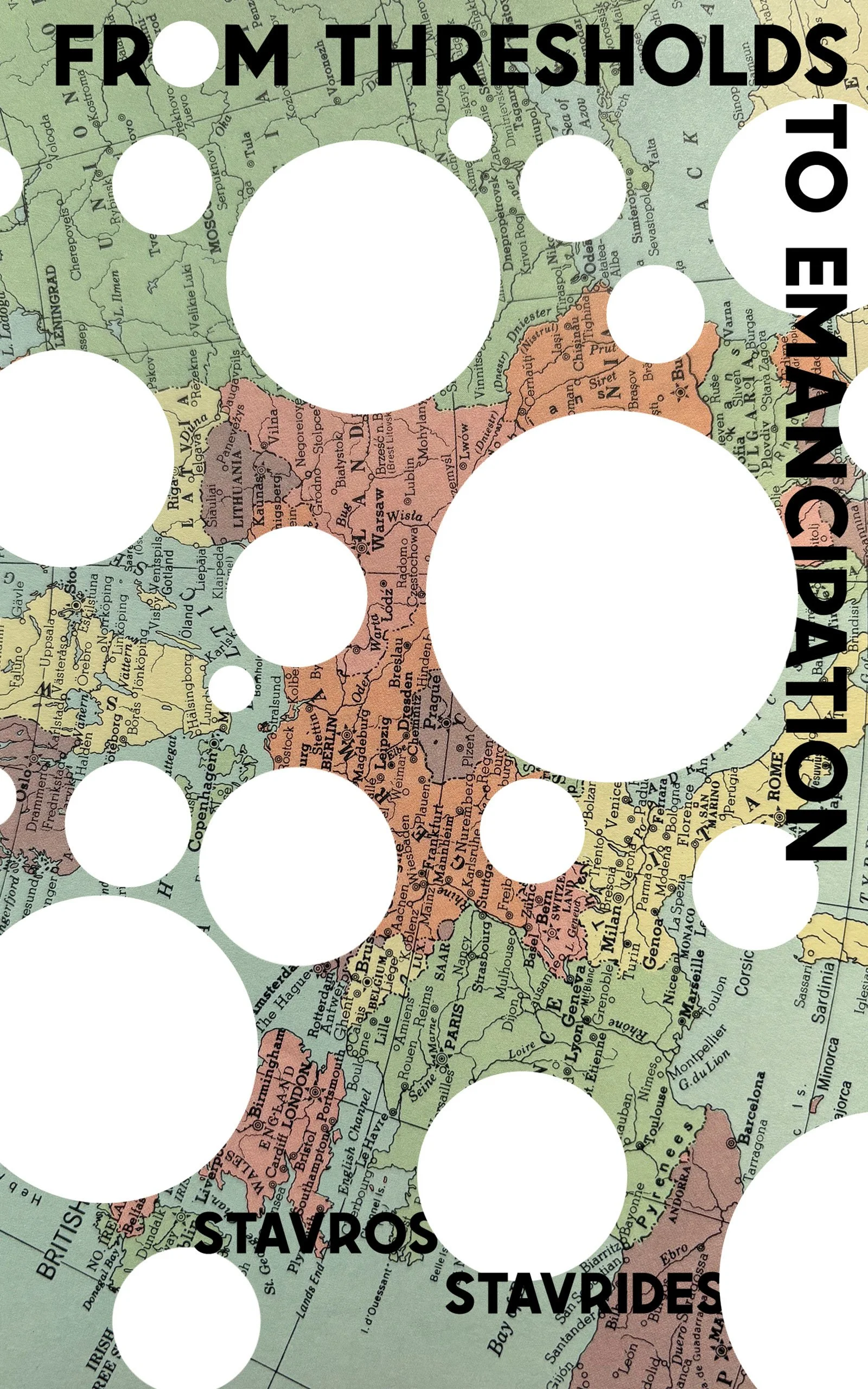
From Thresholds to Emancipation
Forthcoming, ships January 2027
Stavros Stavrides
Could we see in today’s urban movements the seeds of an emancipatory future? And could their experiments in collective life teach us that another city and world are imminently possible?
In more than thirty short, aphoristic texts, architect, activist, and theorist Stavros Stavrides explores the “thresholds” of the urban commons in the present. Drawing primarily on three years of documentation from Athens during and after COVID—originally written as monthly contributions to Stavrides’ commissioned column “Thresholds to Emancipation” for Desinformémonos – Periodismo de abajo—these essays examine how practices of commoning shape subjectivity, space, and political imagination.
Stavrides focuses on affective solidarity, “polyrhythmic” urban life, resistance to the domestication of nature and behavior, and the collective cultivation of what he calls “emancipatory habits.” Across these short texts, the city emerges as a site of struggle and experimentation, where everyday practices can open pathways toward autonomy, radical imagination, and democratic life in common.
This new Common Notions edition is a pocket-sized, interventionist volume, with several texts appearing here for the first time. Situating the project in dialogue with thinkers from Benjamin and Barthes to contemporary media theorists—and with Stavrides’ own earlier work on cities as thresholds—the book balances theoretical framing with political urgency. From Thresholds to Emancipation offers both a conceptual entry point to Stavrides’ work and an open field for the experimental and performative directions the essays pursue.
Product Details
ISBN: 9781945335785
Published: January 12, 2027
Format: Paperback
Size: 5 x 8 in
Page count: 208
-
Stavros Stavrides, architect and activist, is Emeritus Professor at the School of Architecture, National Technical University of Athens, Greece, where he taught graduate courses on housing design (social housing included) and urban design. He still teaches postgraduate courses on research methodology and on the meaning of metropolitan experience.
Until recently he was the head of NTUA Lab Architectural Design and Communication and director of the NTUA postgraduate Program Research in Architecture: Architectural Design — Space — Culture. He has done extensive research fieldwork in Brazil, Uruguay, Argentina and Mexico focused on housing-as-commons and on urban struggles for self-management.
Stavros has written extensively on the urban commons for decades. Some recent publications include: The Politics of Urban Potentiality (London 2024) Housing as Commons (edited with Penny Travlou, London 2023), Common Spaces of Urban Emancipation (Manchester 2019), Common Space: The City as Commons (London 2016, Istanbul 2016, Athens 2019, Lisbon 2021, Milano 2022, forthcoming in Bucharest, Belgrade and Seoul), and Towards the City of Thresholds (Trento 2010, Madrid 2016, Istanbul 2016, New York 2019), as well as numerous articles on spatial theory and the urban commoning culture.
-
Part I: Images
Innocent images?
Repeat or cite?
Graffiti acts
Too near, too faraway
Beyond the frame traps
Masks of absence, masks of presence
Those beautiful ones
“Mothers are right”
Reclaiming historyPart 2: Spaces
Cities in despair — Cities of hope
Stay home?
Whose city?
Safety or security?
Territory as commons
Land commoning
Reclaiming ornamentation
Geometries of the futurePart 3: Practices
Flexibility
Connectivity
Affective solidarities
The taming of nature
“Be creative!”
Collectors
Emancipatory habits
Mimesis can be poetic
Mutual care
The chosen ones
Overcoming racism and assimilationPart 4: Possibilities
Hating democracy
Harmony as a craftsman’s practice
Redeeming modernism
Equality built in common
Threshold institutions
Nostalgia of the possible
Freeing the future
Concrete utopias
Emancipatory time
Learning from the Zapatistas once more…
Forthcoming, ships November 2026
Edited by Carla Orendorff, Anthony Orendorff, Lupita Limon Corrales, Ananya Roy, and Marisa Lemorande
Preface by Robin D. G. Kelley
Urban Studies / Health & Care / Organizing
Written by unhoused people and their allies, We Live in Public is an invitation to revolutionary care in a time of class war.
Los Angeles is one of the richest and most unequal cities in the world, where nine unhoused people die every day. As rent rises, evictions increase, and houselessness grows, the homeless encampment becomes both a symptom of organized abandonment and a site of insurgent knowledge and practice. We Live in Public was conceptualized and written by residents and organizers of one such encampment, Aetna Street, whose experiences offer strategies for solidarity and survival in the face of escalating state violence.
Many people’s worst fear is to be homeless, equating it with social death. But within the encampment, we see people living with wisdom and maps to offer. Throughout this book, Aetna residents and organizers generously share such insights and analysis. We Live in Public insists that these histories provide crucial lessons in modes of collective living and must be at the center of public history and knowledge.
Centering those who care for others on the street, it is an invitation to revolutionary care in the time of war. That war is the more immediate criminalization of homelessness and the longer arc of the unrelenting settlement of the US. We Live in Public is a refusal of such settler-colonial logics in the making of home and place.