
Points of Departure: Refusal of Work and the Crisis of Capitalism: The Collected Writings of Harry Cleaver
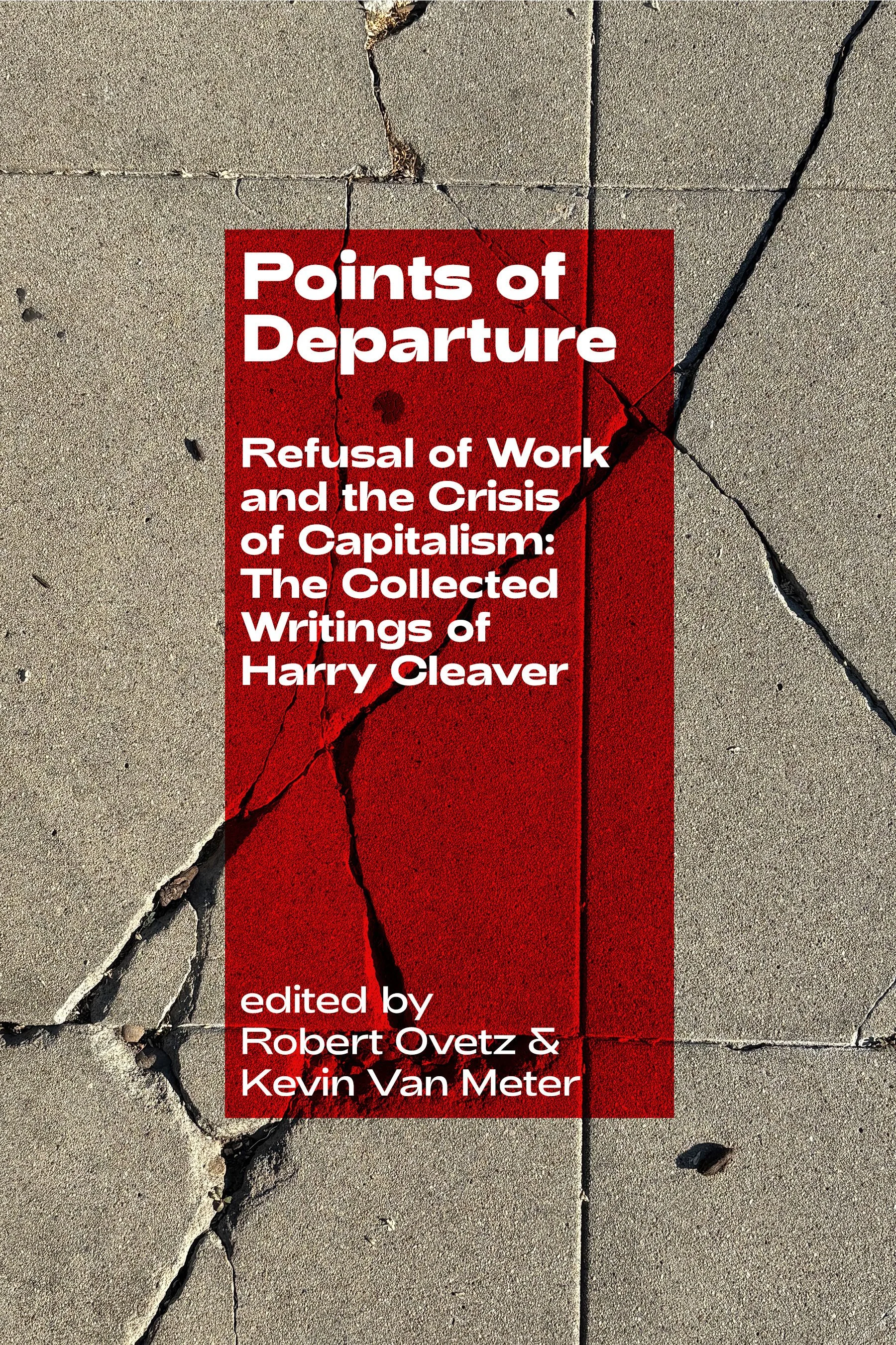
Points of Departure: Refusal of Work and the Crisis of Capitalism: The Collected Writings of Harry Cleaver
Harry Cleaver
Edited by Robert Ovetz and Kevin Van Meter
Capitalism / Labor / Philosophy
Class Compositions
End capitalism before it ends us.
Harry Cleaver is one of the most expansive Marxist theorists of the global class struggle over work of the last fifty years. Points of Departure is the definitive collection of Cleaver’s best unpublished, translated, or lesser known writings—both historical and current—on working class refusal, class composition, unwaged work, debt, and what he calls the “inversion of the class perspective.” This book puts an essential theoretical weapon into the hands of a new generation of militant workers and organizers re-energizing the class struggle. In these essays, Cleaver rereads Marx to address the crisis of capitalism, articulate strategy for the international anticapitalist movement, and to advance our collective search for points of departure from capitalism, so we can end it before it ends us.
Product Details
ISBN: 9781945335747
Published: September 22, 2026
Format: Paperback
Size: 6 x 9 in
Page count: 288
Other Formats
ISBN: 9781945335884
Format: EPUB
Harry Cleaver
Edited by Robert Ovetz and Kevin Van Meter
Capitalism / Labor / Philosophy
Class Compositions
End capitalism before it ends us.
Harry Cleaver is one of the most expansive Marxist theorists of the global class struggle over work of the last fifty years. Points of Departure is the definitive collection of Cleaver’s best unpublished, translated, or lesser known writings—both historical and current—on working class refusal, class composition, unwaged work, debt, and what he calls the “inversion of the class perspective.” This book puts an essential theoretical weapon into the hands of a new generation of militant workers and organizers re-energizing the class struggle. In these essays, Cleaver rereads Marx to address the crisis of capitalism, articulate strategy for the international anticapitalist movement, and to advance our collective search for points of departure from capitalism, so we can end it before it ends us.
-
“This collection of Cleaver’s work, assembled by Ovetz and Van Meter, provides a vital reminder of the enduring power of Marx’s critique as a weapon in the hands of workers. It highlights how the self-activity of the working class continues to make history—today, tomorrow, and into the future. In this time of ‘monsters,’ Cleaver’s writings remind us that capitalism is defined by antagonistic social relations, and that these very contradictions provide the conditions for revolutionary transformation.” —Henry Fowler, Assistant General Secretary, General Federation of Trade Unions (UK) and cofounder of Strike Map
“The boot is on our necks, and this is a hint that our class enemies know we are winning. That is Points of Departure’s gift to readers: reminder after reminder that everyday people have power. Capital knows it and Harry Cleaver wants us to know it too.” —Heather Berg, Notes from the Sex Worker Left: Lumpen Theory
“For more than fifty years now, Harry Cleaver has provided profound insights into contemporary class struggles, thanks to an expressly political reading of the critique of political economy. Alluding to one of Gramsci's favourite aphorisms, Sergio Bologna once wrote that 'clarity is more important than either optimism or pessimism.' Drawing inspiration from the Italian workerist tradition whilst never being its slavish follower, Harry's writings have throughout those decades laid out with startling clarity his analyses of the planetary work machine and its vulnerabilities. This book is essential reading for anyone fed up with capitalism's endless crises and wars.” —Steve Wright, Storming Heaven: Class Composition and Struggle in Italian Autonomist Marxism
“Harry Cleaver’s essays collected in this wonderfully edited volume demonstrate the continuing political relevance and urgency of concepts such as the refusal of work and the self-valorization of the working class.” —Michael Hardt, The Subversive Seventies
“Harry Cleaver has long been an innovative interlocuter of the most pugnacious anti-work tendencies of Italian workerism. This long-awaited and judiciously edited collection consolidates the objective of his deeply political reading of Marx and Capital: to put a weapon in the hands of the working class. His writings on social reproduction, his expansive conception of the working class including unwaged labor, and his inversion of class perspectives with regard to labor, capital and capitalist crisis resonate profoundly in a contemporary context that demands both ardent refusal and militant political recomposition.” —Neil Gray, Take Over the City: Spatial Composition in Italian Autonomy
-
“Offers us a method, a way of understanding and investigating the world. It shows us how we can use Marx and his categories to understand and investigate—and intervene into—the struggles of the present period.” —Morning Star
New Books Network podcast
Cosmonaut: “This collection of Harry Cleaver’s published essays is invaluable for socialist organizers and theoreticians to re-center the working-class as the protagonist of struggle within late capitalist society.”
-
Robert Ovetz holds a PhD in Sociology from the University of Texas–Austin and is a senior lecturer in Political Science at San José State University, where he teaches labor relations in the MPA program and focuses on academic labor organizing and the labor movement. He is the author of When Workers Shot Back (Brill, 2018 and Haymarket, 2019), We the Elites (Pluto, 2022), and the forthcoming Rebels for the System (Haymarket), and is co-authoring a book on organizing against AI in higher education. Robert is co-editor with Kari Lydersen and Kevin Van Meter of Real World Labor, Vol. 4 (Dollars & Sense, 2024). He is also an editor and contributor to critical labor studies volumes, a labor writer for Dollars & Sense, and has been published widely in multiple languages. His writings can be found at sjsu.academia.edu/RobertOvetzPhD.
Kevin Van Meter holds a PhD in Geography, Environment and Society from the University of Minnesota, serves on the editorial board of the Journal of Labor and Society, and is a union organizer and labor educator who writes on contemporary labor issues, labor history, and working-class self-organization. He is co-editor with Kari Lydersen and Robert Ovetz of Real World Labor, Vol. 4 (Dollars & Sense, 2024). He is author of Guerrillas of Desire (AK Press, 2017), co-editor of Uses of a Whirlwind (AK Press, 2010), and has two forthcoming books: Reading Struggles: Working-Class Self-Activity from Detroit to Turin and Back Again (AK Press) and The American Worker: International History, Reception, and Responses (Common Notions). His work has appeared in New Politics, Notes from Below, Dollars and Sense, Truthout, Labor Notes, Work-Bites, The Chief Leader, Perspectives on Anarchist Theory, and other publications.
Harry Cleaver has developed a global following for his decades of work contributing to what he calls “autonomist Marxism,” a Marxism that focuses on the self-organized struggles of workers against capitalism. His classic book Reading Capital Politically (1979) reinterprets Marx to provide an alternative, autonomist perspective not only to more traditional interpretations, but also to others working in the tradition of what today is more commonly known as Italian workerism. Reading Capital Politically has been translated into eight languages, including Korean which was banned by the South Korean government, and has appeared in two editions. Harry has taught at the l’Université de Sherbrooke in Quebec, the New School for Social Research in New York City, and the University of Texas at Austin where he taught for thirty-six years until his retirement in 2012. He has also published 33 Lessons on Capital: Reading Marx Politically (Pluto 2019), Rupturing the Dialectic: The Struggle Against Work, Money and Financialization (AK Press 2019), and The Fragile Juggernaut: Marx and Engels on Capitalism, Class Struggle and Crisis (Brill 2025). The third English language edition of Reading Capital Politically will be published in 2027 by Common Notions.
-
Introductions
Introduction Robert Ovetz and Kevin Van Meter
Political Readings: An Interview with Harry CleaverPart I. Refusal of Work
Short Introduction
Chapter 1: Work is Still the Central Issue: New Words for New Worlds
Chapter 2: Work Refusal and Self-Organization
Chapter 3: Technology as Political WeaponryPart II. The Crisis of Capitalism
Short Introduction
Chapter 4: Theses on Secular Crisis in Capitalism: The Insurpassability of Class Antagonisms
Chapter 5: Close the IMF, Abolish Debt and End Development: A Class Analysis of the International Debt Crisis
Chapter 6: The Crisis of Neoliberalism and Alternatives in the 21st CenturyPart III. Marxist Theory
Short Introduction
Chapter 7: Post Marxist Anarchism: Kropotkin, Self-Valorization, and the Crisis of Marxism
Chapter 8: The Inversion of Class Perspective in Marxian Theory: from Valorization to Self-Valorization
Chapter 9: SocialismConclusion
Notes
Bibliography
Index

Harry Cleaver
Edited by Robert Ovetz and Kevin Van Meter
Capitalism / Labor / Philosophy
Class Compositions
End capitalism before it ends us.
Harry Cleaver is one of the most expansive Marxist theorists of the global class struggle over work of the last fifty years. Points of Departure is the definitive collection of Cleaver’s best unpublished, translated, or lesser known writings—both historical and current—on working class refusal, class composition, unwaged work, debt, and what he calls the “inversion of the class perspective.” This book puts an essential theoretical weapon into the hands of a new generation of militant workers and organizers re-energizing the class struggle. In these essays, Cleaver rereads Marx to address the crisis of capitalism, articulate strategy for the international anticapitalist movement, and to advance our collective search for points of departure from capitalism, so we can end it before it ends us.