
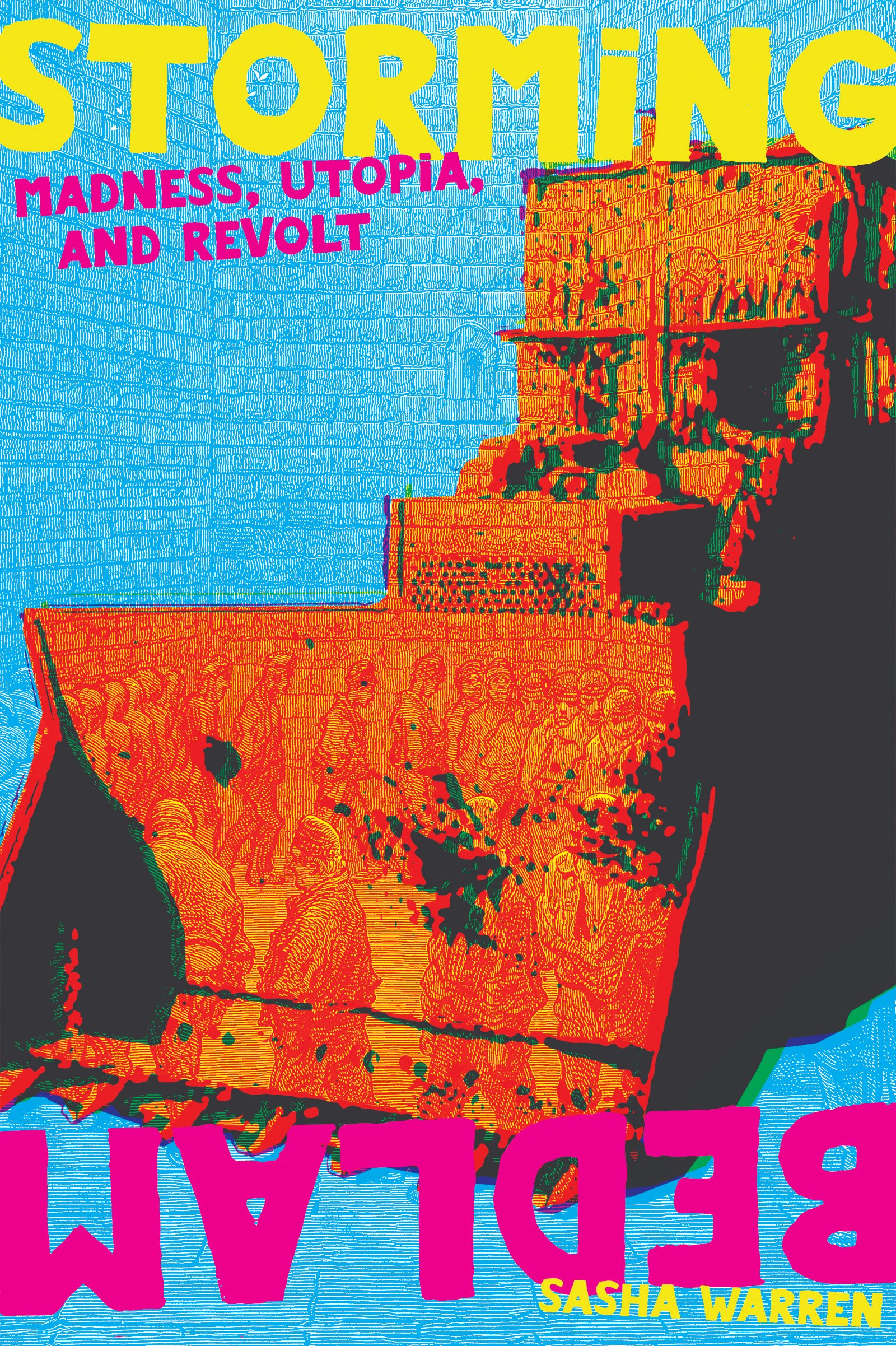
Storming Bedlam: Madness, Utopia, and Revolt

Storming Bedlam: Madness, Utopia, and Revolt
Sasha Warren
Storming Bedlam reimagines mental health care and its radical possibilities in the context of its global development under capitalism.
We live in a world oversaturated by new mental health programs, methods, and shifts that simply pile up and seem to lead nowhere. Storming Bedlam: Madness, Mental Health, and Revolt suggests that psychiatry must face its repeated failures in the light of its utopian aspirations. Only by doing so can the intense contradictions that animate the world of mental health care be adequately conceptualized and situated as the basis for a future therapeutic practice.
In a radical rereading of the history, theory, and practice of psychiatry under capitalism that emphasizes the utopian thrust of the psychiatric revolution, Storming Bedlam pushes totalizing and often idealistic visions of mental health care to their limits to chart another path. This is the first global and comparative reflection on radical psychiatric currents that ties them directly to the original founding acts of the field. Here, in an original and compelling account of the field’s radical history, moral treatment is read in the light of the utopian socialist movement, as the French Institutional Psychotherapy of Félix Guattari is put into conversation with Brazilian art therapy of Nise da Silveira, Mexican antipsychiatry’s reflections on violence are compared with Argentinian psychoanalysis and Frantz Fanon’s anticolonial psychiatric practice, and the Italian Democratic Psychiatry movement and Brazilian anti-institutional politics are contrasted with the North American anti-psychiatry currents beginning in the 1960s–70s counterculture, and more.
PRODUCT DETAILS
ISBN: 9781942173892
Published: March 2024
Format: Paperback
Size: 6 x 9 in
Page count: 388
Other Formats
ISBN: 9781945335051
Format: EPUB
Storming Bedlam reimagines mental health care and its radical possibilities in the context of its global development under capitalism.
-
“Storming Bedlam presents the history of psychiatry—including bio, social, democratic and demolition psychiatry, as Warren calls it—as a social and political problem. This sharp genealogy is a must read that does not fall into the binary of ‘coercive psychiatry’ versus ‘bad/good anti-psychiatry.’ Instead, it paints a complex picture that analyzes the asylum as a site for critique and experimentation in relation to left movements and revolutions.” —Liat Ben-Moshe, author of Disability Incarcerated: Imprisonment and Disability in the United States and Canada and Decarcerating Disability: Deinstitutionalization and Prison Abolition
“Storming Bedlam is a sweeping work of meticulous, thoughtful scholarship and a welcome addition to the canons of mad studies and critical histories of psychiatry. Navigating deftly and sensitively between psychiatry and anti-psychiatry, Sasha Warren interrogates this binary in its context of late-stage capitalism that defines madness, sanity, and care in terms of labor and surplus, dictating the parameters of our very lives. As Warren writes: ‘We are on fire, and so is the Earth we stand on.’ This deeply important book meets the urgent, burning times we inhabit with the unflinching ‘weeping gaze of the clown.’ Storming Bedlam is a book that inflames the imagination; may it provide fuel and sustenance to all seeking to dismantle oppressive technologies of harm and build a world rooted in true care and collective liberation.” —Leah Harris, psychiatric survivor, activist, and independent journalist
“Sasha Warren’s Storming Bedlam: Madness, Utopia, and Revolt is a thought-provoking book that challenges conventional narratives around psychiatry and anti-psychiatry by uncovering the radical and reactionary forces that have shaped this history. It is a bold and original work of scholarship that invites us to rethink the past, present, and future of psychiatric revolutions.” —Awais Aftab, Clinical Assistant Professor of Psychiatry at Case Western Reserve University and editor of Conversations in Critical Psychiatry
-
Sasha Durakov Warren is a writer based in Minneapolis. His experiences within the psychiatric system and commitment to radical politics led him to cofound the group Hearing Voices Twin Cities, which provides an alternative social space for individuals to discuss often stigmatized extreme experiences and network with one-another. Following the George Floyd Uprising in 2020, he founded the project Of Unsound Mind to trace the histories of psychiatry, social work, and public health's connections to policing, prisons, and various disciplinary and managerial technologies.
Forthcoming, ships November 2026
Edited by Carla Orendorff, Anthony Orendorff, Lupita Limon Corrales, Ananya Roy, and Marisa Lemorande
Preface by Robin D. G. Kelley
Urban Studies / Health & Care / Organizing
Written by unhoused people and their allies, We Live in Public is an invitation to revolutionary care in a time of class war.
Los Angeles is one of the richest and most unequal cities in the world, where nine unhoused people die every day. As rent rises, evictions increase, and houselessness grows, the homeless encampment becomes both a symptom of organized abandonment and a site of insurgent knowledge and practice. We Live in Public was conceptualized and written by residents and organizers of one such encampment, Aetna Street, whose experiences offer strategies for solidarity and survival in the face of escalating state violence.
Many people’s worst fear is to be homeless, equating it with social death. But within the encampment, we see people living with wisdom and maps to offer. Throughout this book, Aetna residents and organizers generously share such insights and analysis. We Live in Public insists that these histories provide crucial lessons in modes of collective living and must be at the center of public history and knowledge.
Centering those who care for others on the street, it is an invitation to revolutionary care in the time of war. That war is the more immediate criminalization of homelessness and the longer arc of the unrelenting settlement of the US. We Live in Public is a refusal of such settler-colonial logics in the making of home and place.