
Yes, It's Possible! Enamel Pin
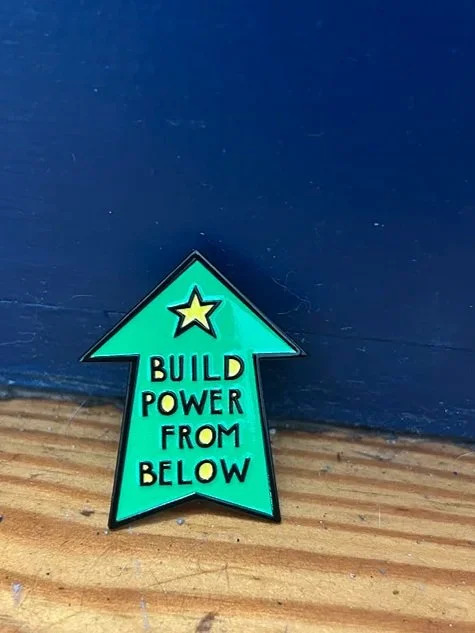
Yes, It's Possible! Enamel Pin
Build Power From Below!
This pin was designed by Josh MacPhee to accompany the publication of Yes, It’s Possible! A Handbook For Building Power From Below by João França and The Platform for People Affected by Mortgages (PAH).
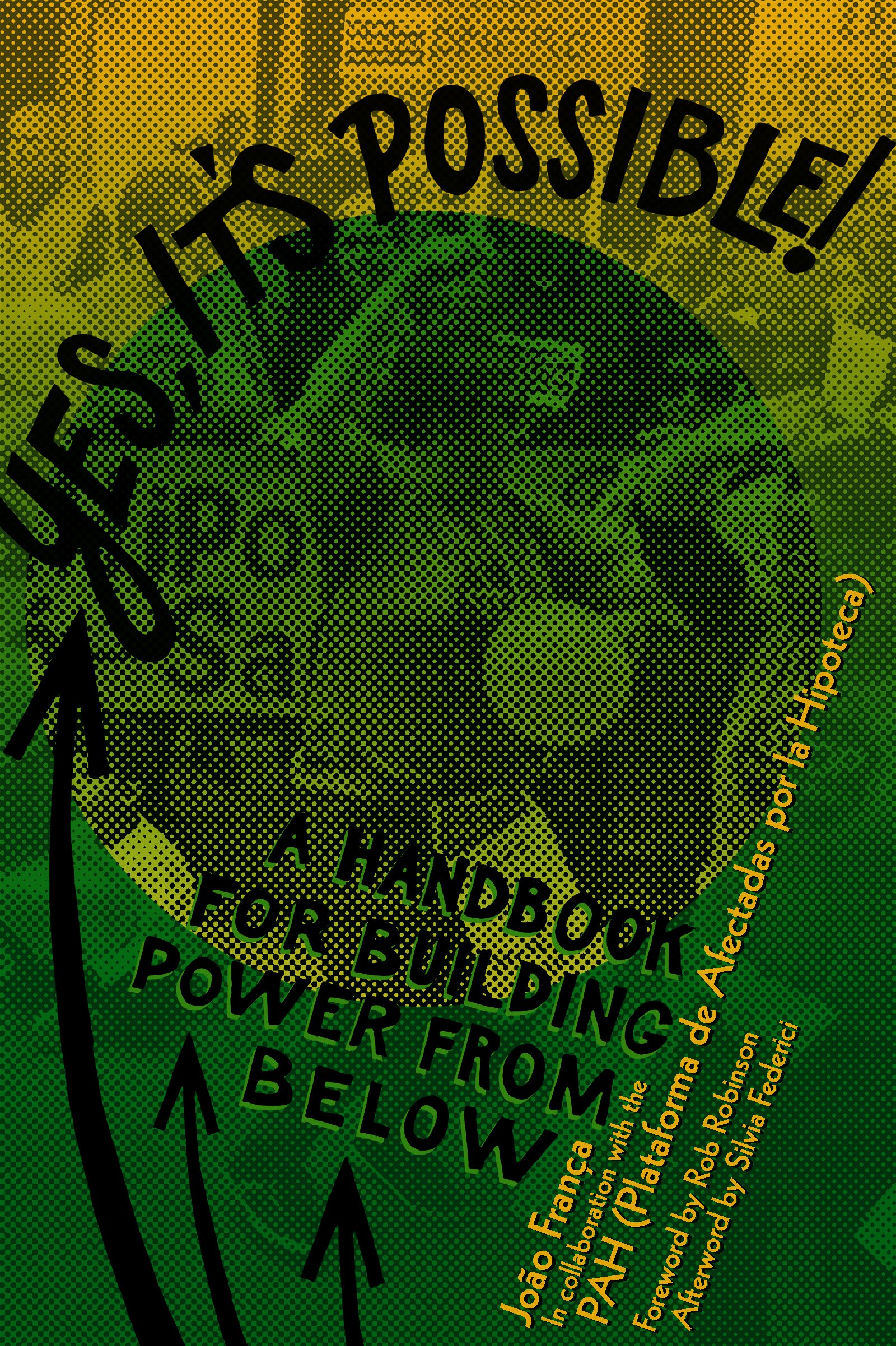
João França and The Platform for People Affected by Mortgages (PAH)
Preface by Rob Robinson
Afterword by Silvia Federici
Organizing / Social Movements / Urban Studies
A handbook for achieving social change through collective action based on lessons from a revolutionary movement’s struggle for housing justice in Spain.
Founded in Spain in 2009 as an immediate response to the devastating effects of the 2008 Global Financial Crisis, the Platform for People Affected by Mortgages (Plataforma de Afectados por la Hipoteca – PAH) has since grown into a nationwide movement with over two hundred local chapters. Together, they have stopped thousands of evictions, negotiated with banks, forced legislative change, occupied fifty buildings, and, most importantly, rescued thousands of people from the edge of the abyss. It achieved all of this without backing from any party, union, or major NGO, and without full-time staff or external funding.
As the PAH faced off some of the country’s most powerful institutions, its members learned how to organize themselves, how to look after one another, how to do politics from the street, and how to bring about legislative reform. They managed to change the dominant narrative that blamed the victims of speculation on the housing market, they’ve won broad popular support, and through civil disobedience, they forced political parties to pass laws and pressured wealthy property owners and international corporations to negotiate and accept their demands.
How did they do this? This handbook collects and curates more than a decade-and-a-half worth of experience in social movement and community organizing. The lessons offered here, ranging from how to run a citizens’ assembly and manage conflicts to reflections on negotiation tactics, street-level organizing, and collective care, are drawn from the PAH’s struggle for housing justice, but can be useful for groups of citizens fighting collectively anywhere in the world. The PAH’s message to the world? “Only by organizing in the streets can we force legislative change, and only through legislative change can we gain more rights.”

Danielle Chynoweth & Elizabeth Adams
How can we empower ourselves and our communities to make lasting social change?
Remaking Democracy is a guidebook for social change. We are at a watershed moment of rising fascism and rising seas: our institutions are failing us, health crises ravage our communities, and the natural world has been thrust into catastrophic climate freefall. Despair threatens to overtake hope in our visions of the future.
In these pages, organizers and teachers Danielle Chynoweth and Elizabeth Adams offer analysis and strategy for sustainable transformation. This accessible and practical resource presents case studies alongside a design toolkit that equips readers to participate in creating the abundant worlds we want. Remaking Democracy empowers us—individually and in groups—to make lasting social change on every level, so that we who are affected by systems can become their creators.
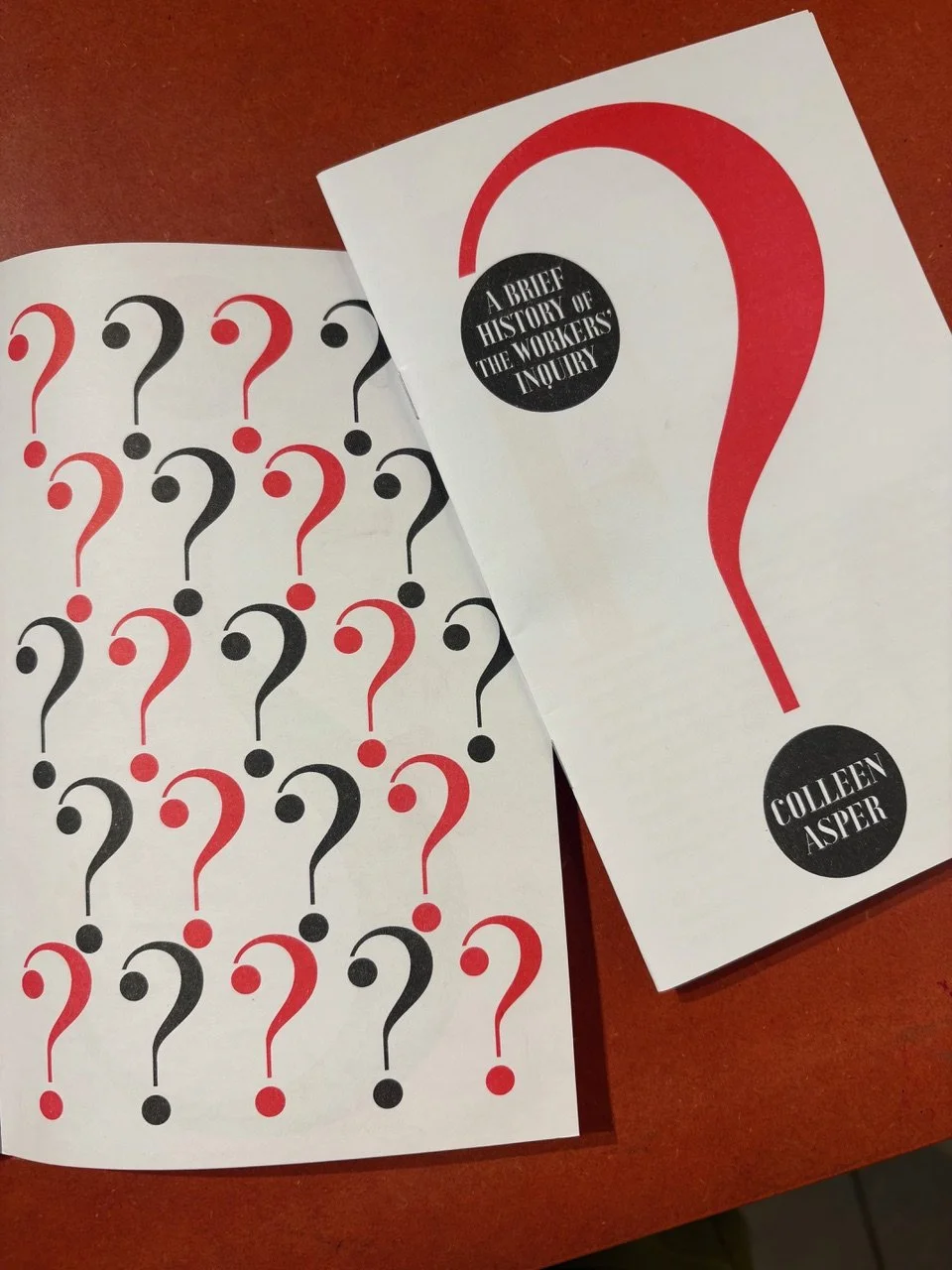
Colleen Asper
A Brief History of the Workers’ Inquiry introduces and reinvigorates the long tradition of research and inquiry coming from workers’ initiative, as part of their self-activity and organizing against their bosses, and ultimately as the sharpest tool in the arsenal of class struggle: collective intelligence wielded in solidarity against the exploitative and oppressive conditions that extract our time, power, and value from our very laboring together. In this short pamphlet, we enter the “hidden abode” of production, where everywhere our knowledge as workers’ haunts the boss—from contemporary offices and networked workplaces, to the factories where Karl Marx first employed the technique in 1880 in search of “an exact and postive knowledge” of the class struggles, to its uses by the Johnson-Forest Tendency in 1947 in the auto factories of New Jersey and Detroit, to postwar France, where it was again taken up by Socialism ou Barbarie, and then again in the militant struggles of Italy in the 60s and 70s. This long tradition has accompanied many moments of worker militancy, including recent ones, and it's a hypothesis worth testing that it will continue to be an essential tool of struggles to come.
Forthcoming, ships November 2026
Edited by Carla Orendorff, Anthony Orendorff, Lupita Limon Corrales, Ananya Roy, and Marisa Lemorande
Preface by Robin D. G. Kelley
Urban Studies / Health & Care / Organizing
Written by unhoused people and their allies, We Live in Public is an invitation to revolutionary care in a time of class war.
Los Angeles is one of the richest and most unequal cities in the world, where nine unhoused people die every day. As rent rises, evictions increase, and houselessness grows, the homeless encampment becomes both a symptom of organized abandonment and a site of insurgent knowledge and practice. We Live in Public was conceptualized and written by residents and organizers of one such encampment, Aetna Street, whose experiences offer strategies for solidarity and survival in the face of escalating state violence.
Many people’s worst fear is to be homeless, equating it with social death. But within the encampment, we see people living with wisdom and maps to offer. Throughout this book, Aetna residents and organizers generously share such insights and analysis. We Live in Public insists that these histories provide crucial lessons in modes of collective living and must be at the center of public history and knowledge.
Centering those who care for others on the street, it is an invitation to revolutionary care in the time of war. That war is the more immediate criminalization of homelessness and the longer arc of the unrelenting settlement of the US. We Live in Public is a refusal of such settler-colonial logics in the making of home and place.